


How we get information: careful observation


 About this lesson
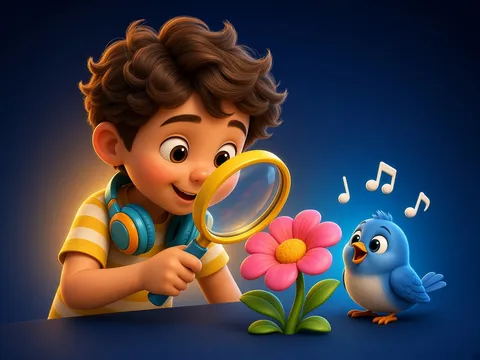
When we look carefully we see small details: petals, a beetle’s legs. A magnifying glass makes things look bigger. When we listen carefully we tell sounds apart: birdsong, the wind. Headphones bring sound to our ears, but we keep the volume low.
 What the book shows

In computer science the child first learns to think through unplugged games: recognising information, ordering steps and learning safety rules.
Textbook link:
This is not the textbook’s text but a short description of the topic. Check the exact page in your own textbook.
 The lesson step by step
- 1
Warm-up5 min
Mystery box.
- 2
New topic10 min
Careful observation.
- 3
Practice10 min
Using a magnifier.
- 4
Game10 min
Guess the sounds.
- 5
Wrap-up5 min
Observation diary.
 Let’s understand
For the student Simple language
The boy looks at a flower through a magnifying glass while a bird sings.
| Sense | Helper | What we learn |
|---|---|---|
| 👀 sight | 🔍 magnifier | small details |
| 👀 sight | 👓 glasses | seeing clearly |
| 👂 hearing | 🎧 headphones | sound, music, lessons |
 For the parent
How to help
- Look at leaves and stones with a magnifier on a walk.
- Close your eyes and count the sounds for a minute.
- Check the headphone volume together.
 For the teacher
 Lesson goals
- Observe carefully by seeing and hearing and know helpful tools (magnifier, headphones).
How to teach it
- Unplugged games, cards, role play, discussion
 Differentiation
- Weaker pupils: 2–3 steps; stronger pupils build their own algorithm
 Questions for the class
- How do we observe carefully and which tools help?
 How to check
The pupil notes 5 details and picks the right tool.
 Scientific Scientific language
Observation is a scientist’s job
Scientists look and listen carefully and write down what they notice. This is observation.
Protecting our ears
Very loud sound in headphones tires our hearing. It is advised to keep the volume below half and take breaks.
Self-study
Step by step
- Look carefully: what do I see?
- Listen carefully: what do I hear?
- Write or draw what I noticed.
Going deeper
 Scientific language: for older students, parents and teachers.
A microscope is far stronger than a magnifier: it shows tiny living things too small to see with the eye.
 Play and check
Which helper do we need?
 How to write it down
- Look at a leaf through a magnifier and draw it.
- Write 3 details you noticed.
How the classwork looks in the notebook
Sample: the date and heading follow this country’s notebook rules.
 Watch out: common mistakes
 Where it helps in life
- Pictures, text, sound: signs
- An observation diary
 At home
Core
- Look carefully at one thing for 2 minutes and write 5 details.
Extra ⭐
- Listen by a window for 3 minutes and write the sounds.
How to do it
- Do the task with a grown-up.
- Explain in words what you noticed.
Answers for parents
For example, a leaf: green, jagged edges, a thick middle vein, a tiny hole, a paler back.
Step-by-step homework solution — Show the solution (try it yourself first)
Observe
- A bird: its colour, size and song: three facts from eyes and ears.
How the homework looks in the notebook
Sample: the date and heading follow this country’s notebook rules.

 About cookies