


What is information? Storing and sending it
 About this lesson
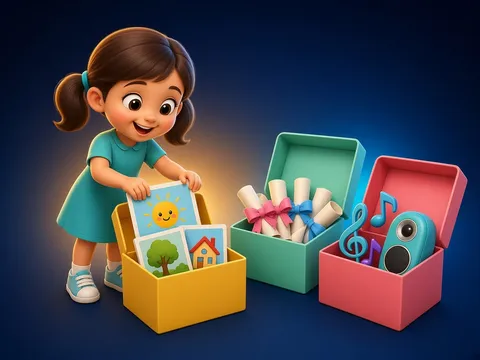
We receive information (listen, read), store it (write in a notebook, take photos, mark a calendar) and send it (write a letter, phone someone). Our memory stores information too, but a notebook never forgets.
 What the book shows

In computer science the child first learns to think through unplugged games: recognising information, ordering steps and learning safety rules.
Textbook link:
This is not the textbook’s text but a short description of the topic. Check the exact page in your own textbook.
 The lesson step by step
- 1
Warm-up5 min
A mystery envelope.
- 2
New topic10 min
Receive, store, send.
- 3
Practice10 min
Sort the examples.
- 4
Game10 min
“Telephone” game.
- 5
Wrap-up5 min
Family calendar.
 Let’s understand
For the student Simple language

| What we do | Example |
|---|---|
| 📥 receive | listen to the teacher, read a book |
| 🗂️ store | a notebook, a photo album, a calendar |
| 📤 send | a letter, a phone call |
 For the parent
How to help
- Write birthdays on the family calendar together.
- Send granny a little letter or card.
- Ask: how can we store this information?
 For the teacher
 Lesson goals
- Know what we do with information (receive, store, send) and give an example of each.
How to teach it
- Unplugged games, cards, role play, discussion
 Differentiation
- Weaker pupils: 2–3 steps; stronger pupils build their own algorithm
 Questions for the class
- What do we do with information? Give an example of each.
 How to check
The pupil names the 3 actions with examples.
 Scientific Scientific language
Information carriers
Anything that stores information is a carrier: paper, a photo, computer memory. Long ago, stone and clay tablets were carriers too.
Ways of sending
A letter takes days by post; a phone call arrives at once. The way we send changes the speed.
Self-study
Step by step
- I received information.
- If it matters, I write it down or take a photo.
- If someone else needs it, I send it.
Going deeper
 Scientific language: for older students, parents and teachers.
In the game of “telephone” a message changes as it passes from person to person. That is why important information is safer in writing.
 Play and check
Receive, store or send?
 How to write it down
- Draw three columns: receive, store, send.
- Draw 2 examples in each.
How the classwork looks in the notebook
Sample: the date and heading follow this country’s notebook rules.
 Watch out: common mistakes
 Where it helps in life
- Processing information
- Computer memory
 At home
Core
- Write your family’s birthdays on a calendar or in a notebook.
Extra ⭐
- Write a short letter to a friend or your granny.
How to do it
- Do the task with a grown-up.
- Explain in words what you noticed.
Answers for parents
A calendar stores information; a letter sends it. A letter needs a greeting, the main idea and a goodbye.
Step-by-step homework solution — Show the solution (try it yourself first)
Think
- The teacher announced a trip: we receive (listen), store (write it down) and send (tell our parents).
How the homework looks in the notebook
Sample: the date and heading follow this country’s notebook rules.

 About cookies