


Food chains: who eats whom?


 About this lesson
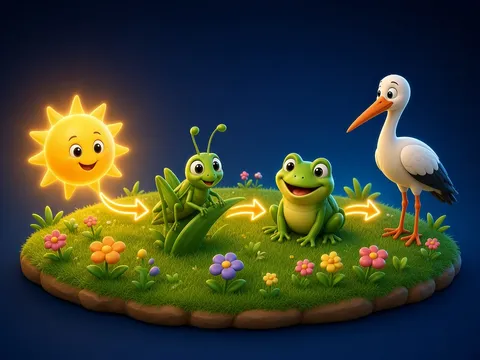
All living things need food. Plants make their own food using sunlight, so a chain always starts with a plant. Plant-eaters (grasshoppers, rabbits) eat plants, and predators (frogs, foxes, eagles) eat plant-eaters. For example: grass → grasshopper → frog → snake → eagle. The arrow means “is eaten by”. Fungi, worms and some bacteria break down dead plants and animals and make the soil rich. If one link disappears, the others suffer too.
 What the book shows

The textbook usually gives a big picture, questions and a small observation or project task. Talk about the picture, link the questions to everyday life and carry on the observation at home.
Textbook link:
This is not the textbook’s text but a short description of the topic. Check the exact page in your own textbook.
 The lesson step by step
- 1
Warm-up5 min
Who eats what?
- 2
New topic10 min
Plants and the Sun.
- 3
Practice10 min
Building a chain.
- 4
Game10 min
Decomposers.
- 5
Wrap-up5 min
If a link disappears?
 Let’s understand
For the student Simple language
| Link | What it does | Example |
|---|---|---|
| 🌿 plant | makes food using sunlight | grass, leaves |
| 🦗 plant-eater | eats plants | grasshopper, rabbit |
| 🦊 predator | eats animals | fox, eagle |
| 🍄 decomposer | turns remains into soil | mushroom, worm |
 For the parent
How to help
- Watch who eats whom in a park or garden together.
- At dinner ask: which plant does this food start from?
 For the teacher
 Lesson goals
- Know how a food chain works, tell plants, plant-eaters, predators and decomposers apart, and build a simple chain.
How to teach it
- Observation, picture talk, group work, mini-project
 Differentiation
- Weaker pupils: with pictures and cards; stronger pupils: find an extra fact and tell the class
 Questions for the class
- How are living things linked in nature?
 How to check
The pupil builds a food chain starting with a plant and names the links.
 Scientific Scientific language
It all starts with the Sun
Plants can’t make food without sunlight, so every chain depends on the Sun.
Eating everything
A bear eats both plants and animals; such animals are called omnivores.
Self-study
Step by step
- Does my chain start with a plant?
- The arrow shows “is eaten by”.
- I can tell plant-eaters from predators.
- I remembered the decomposers.
Going deeper
 Scientific language: for older students, parents and teachers.
In nature, chains link up into a “food web”: a fox may eat rabbits, mice and berries.
 Play and check
What is this living thing in the chain?
 How to write it down
- Draw a 4-link food chain for a forest or a lake.
- Label each link “plant”, “plant-eater” or “predator”.
How the classwork looks in the notebook
Sample: the date and heading follow this country’s notebook rules.
 Watch out: common mistakes
 Where it helps in life
- Protecting nature
- Natural communities (forest, meadow, lake)
 At home
Core
- Write which plant 3 of your foods start from.
Extra ⭐
- Build a food chain for a lake.
How to do it
- Observe at home or talk with an adult.
- Write or draw what you found.
Answers for parents
For example: bread → wheat; cheese → milk → cow → grass. A lake: water plants → small fish → big fish → cormorant.
Step-by-step homework solution — Show the solution (try it yourself first)
Think
- If all the grasshoppers in a meadow disappeared, frogs would go hungry and then snakes would decline. Every link matters.
How the homework looks in the notebook
Sample: the date and heading follow this country’s notebook rules.

 About cookies