


Let’s protect nature


 About this lesson
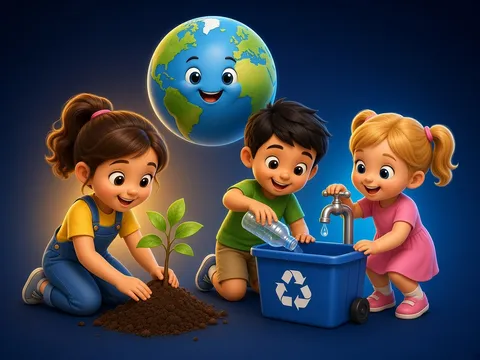
People get water, air, food and wood from nature. But litter, dirty water, cutting down forests and hunting harm plants and animals. Plants and animals in danger of dying out are listed in the Red Book; hunting or picking them is forbidden. National parks and reserves are set up to protect nature; for example, goitered gazelles are protected in Shirvan National Park. Everyone can help: put litter in the bin, save water and electricity, plant trees, feed birds, and collect paper and plastic separately.
 What the book shows

The textbook usually gives a big picture, questions and a small observation or project task. Talk about the picture, link the questions to everyday life and carry on the observation at home.
Textbook link:
This is not the textbook’s text but a short description of the topic. Check the exact page in your own textbook.
 The lesson step by step
- 1
Warm-up5 min
What does nature give us?
- 2
New topic10 min
What harms it.
- 3
Practice10 min
The Red Book.
- 4
Game10 min
National parks.
- 5
Wrap-up5 min
My steps.
 Let’s understand
For the student Simple language
| Harm | What can I do? |
|---|---|
| 🗑️ litter | use the bin, sort paper and plastic |
| 🚰 wasting water | turn off the tap |
| 🪓 cutting down trees | plant trees, save paper |
| 🌸 picking rare flowers | leave the flower where it grows |
 For the parent
How to help
- Set up separate boxes for paper and plastic at home.
- Plant a tree or flower together and look after it.
 For the teacher
 Lesson goals
- Know how people affect nature, explain what the Red Book and national parks are for, and show everyday ways to protect nature.
How to teach it
- Observation, picture talk, group work, mini-project
 Differentiation
- Weaker pupils: with pictures and cards; stronger pupils: find an extra fact and tell the class
 Questions for the class
- How can we protect nature?
 How to check
The pupil sorts helpful and harmful actions and explains the Red Book and national parks.
 Scientific Scientific language
Why is the Red Book red?
Red is a danger signal: “careful, this living thing needs protecting”.
Plastic lasts
Plastic takes very many years to break down in nature, so collecting it separately matters.
Self-study
Step by step
- I don’t drop litter.
- I save water and electricity.
- I don’t pick rare plants.
- I can say how I help nature.
Going deeper
 Scientific language: for older students, parents and teachers.
A tree gives oxygen, homes for birds and shade for many years, so planting one is a long-lasting gift.
 Play and check
Does this help nature or harm it?
 How to write it down
- Draw a “Protect nature” poster with 3 rules.
- Write how you save water and electricity at home.
How the classwork looks in the notebook
Sample: the date and heading follow this country’s notebook rules.
 Watch out: common mistakes
 Where it helps in life
- Nature of Azerbaijan
- Ecology and climate
 At home
Core
- For a week, collect paper and plastic separately at home.
Extra ⭐
- Write 3 sentences about an animal in the Red Book.
How to do it
- Observe at home or talk with an adult.
- Write or draw what you found.
Answers for parents
For example: The goitered gazelle is fast and shy. It is protected because its numbers fell. Gazelles live in Shirvan National Park.
Step-by-step homework solution — Show the solution (try it yourself first)
Think
- After a picnic in the forest we take our litter home and put the campfire out completely with water.
How the homework looks in the notebook
Sample: the date and heading follow this country’s notebook rules.

 About cookies