


The Solar System


 About this lesson
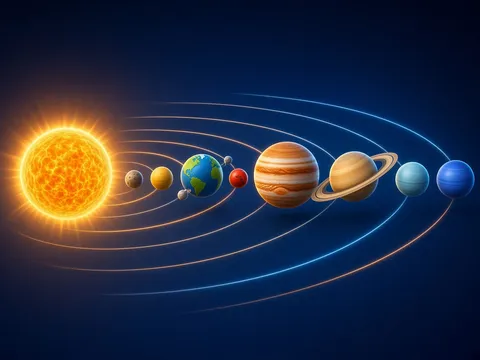
The Sun is a star that gives light and heat. Eight planets travel around it. Starting from the Sun: Mercury, Venus, Earth, Mars, Jupiter, Saturn, Uranus, Neptune. Earth is the third planet from the Sun. The biggest planet is Jupiter, and Saturn has beautiful rings. Earth spins on its axis once a day (24 hours), which gives us day and night. It goes all the way round the Sun once a year (about 365 days). The Moon is Earth’s natural satellite; it has no light of its own and reflects sunlight.
 What the book shows

The textbook usually gives a big picture, questions and a small observation or project task. Talk about the picture, link the questions to everyday life and carry on the observation at home.
Textbook link:
This is not the textbook’s text but a short description of the topic. Check the exact page in your own textbook.
 The lesson step by step
- 1
Warm-up5 min
Looking at the night sky.
- 2
New topic10 min
The Sun is a star.
- 3
Practice10 min
8 planets.
- 4
Game10 min
Day and year.
- 5
Wrap-up5 min
Planet model.
 Let’s understand
For the student Simple language
| № | Planet | One fact |
|---|---|---|
| 1 | Mercury | closest to the Sun |
| 2 | Venus | the hottest planet |
| 3 | Earth | our home; the Moon is its satellite |
| 4 | Mars | the red planet |
| 5 | Jupiter | the biggest planet |
| 6 | Saturn | bright rings |
| 7 | Uranus | spins on its side |
| 8 | Neptune | farthest from the Sun |
 For the parent
How to help
- Look at the Moon together each evening for a week and draw its shape.
- Make up a rhyme or game to remember the planets.
 For the teacher
 Lesson goals
- Name the 8 planets in order, know how the Earth moves around the Sun and spins on its axis, and that the Moon is Earth’s satellite.
How to teach it
- Observation, picture talk, group work, mini-project
 Differentiation
- Weaker pupils: with pictures and cards; stronger pupils: find an extra fact and tell the class
 Questions for the class
- Where is Earth in space?
 How to check
The pupil names the 8 planets in order, explains day and year and knows the Moon is a satellite.
 Scientific Scientific language
Why is Venus hottest?
Its thick air traps heat, so it is even hotter than Mercury.
Why does the Moon change shape?
The Moon travels around Earth and we see different amounts of its sunlit side.
Self-study
Step by step
- I can name the 8 planets in order.
- Earth is the third.
- A day is one spin, a year is one trip round the Sun.
- The Moon is a satellite, not a star.
Going deeper
 Scientific language: for older students, parents and teachers.
Sunlight takes about 8 minutes to reach Earth, so we see the Sun as it was 8 minutes ago.
 Play and check
What is it?
 How to write it down
- Draw the Solar System: the Sun and the 8 planets in order.
- Write one fact under each planet.
How the classwork looks in the notebook
Sample: the date and heading follow this country’s notebook rules.
 Watch out: common mistakes
 Where it helps in life
- Why seasons change
- Stars and constellations
 At home
Core
- Make the planets from modelling clay.
Extra ⭐
- Watch and draw the Moon for a week.
How to do it
- Observe at home or talk with an adult.
- Write or draw what you found.
Answers for parents
Jupiter is the biggest ball, then Saturn, then Uranus and Neptune; Earth and Venus are medium; Mars and Mercury are the smallest. The Moon’s shape changes bit by bit during the week.
Step-by-step homework solution — Show the solution (try it yourself first)
Think
- If Earth didn’t spin, one side would always have day and the other always night.
How the homework looks in the notebook
Sample: the date and heading follow this country’s notebook rules.

 About cookies