


How does our body work?


 About this lesson
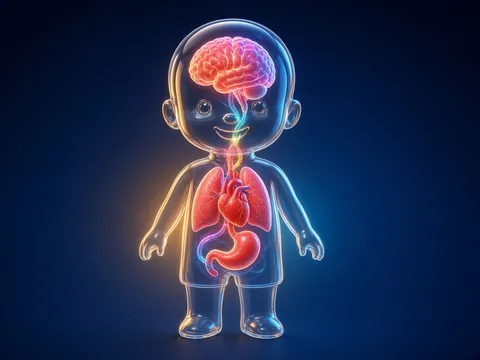
Our body works like a team. The brain controls the whole body: we think, remember and move. The heart is a muscle that pumps blood around the body; blood carries oxygen and food. When we breathe in, the lungs take oxygen from the air; when we breathe out, they get rid of carbon dioxide. The stomach and intestines digest food, turning it into things the body can use. The skeleton holds us up and protects organs: the skull protects the brain, the ribs protect the heart and lungs. Muscles move the bones. To stay healthy the body needs exercise, good food, water and sleep.
 What the book shows

The textbook usually gives a big picture, questions and a small observation or project task. Talk about the picture, link the questions to everyday life and carry on the observation at home.
Textbook link:
This is not the textbook’s text but a short description of the topic. Check the exact page in your own textbook.
 The lesson step by step
- 1
Warm-up5 min
Listening to the heart.
- 2
New topic10 min
The organ team.
- 3
Practice10 min
Skeleton and muscles.
- 4
Game10 min
Organ map.
- 5
Wrap-up5 min
Healthy habits.
 Let’s understand
For the student Simple language
| Organ | Job | How I look after it |
|---|---|---|
| 🧠 brain | controls the body | sleep well, wear a helmet |
| 🫀 heart | pumps blood | keep moving |
| 🫁 lungs | breathe | play in fresh air |
| 🍽️ stomach | digests food | eat slowly and healthily |
| 🦴 skeleton and muscles | support and movement | sit up straight, do sport |
 For the parent
How to help
- Feel your child’s heartbeat before and after running.
- Watch how the chest rises when breathing in.
 For the teacher
 Lesson goals
- Know the main organs (brain, heart, lungs, stomach) and what they do, explain the role of the skeleton and muscles, and link them to healthy habits.
How to teach it
- Observation, picture talk, group work, mini-project
 Differentiation
- Weaker pupils: with pictures and cards; stronger pupils: find an extra fact and tell the class
 Questions for the class
- How do the parts of our body work together?
 How to check
The pupil explains 4 organs’ jobs, knows the role of bones and muscles, and names healthy habits.
 Scientific Scientific language
How many bones?
An adult skeleton has 206 bones.
A tireless heart
The heart works all your life, even while you sleep.
Self-study
Step by step
- I can say what each organ does.
- The skeleton protects organs.
- Four things for health: exercise, food, water, sleep.
Going deeper
 Scientific language: for older students, parents and teachers.
Babies are born with more bones; some join together as they grow, leaving 206 in an adult.
 Play and check
Which organ does this?
 How to write it down
- Draw a body outline and mark where 4 organs are.
- Write each organ’s job next to it.
How the classwork looks in the notebook
Sample: the date and heading follow this country’s notebook rules.
 Watch out: common mistakes
 Where it helps in life
- First aid
- Food and digestion
 At home
Core
- Record how much water you drank and how many hours you slept in one day.
Extra ⭐
- Count your breaths in 1 minute.
How to do it
- Observe at home or talk with an adult.
- Write or draw what you found.
Answers for parents
Answers vary. Children at rest breathe roughly 20 times a minute, and faster after running.
Step-by-step homework solution — Show the solution (try it yourself first)
Think
- When we run, our muscles need more oxygen, so the heart beats faster and we breathe faster.
How the homework looks in the notebook
Sample: the date and heading follow this country’s notebook rules.

 About cookies