


First aid


 About this lesson
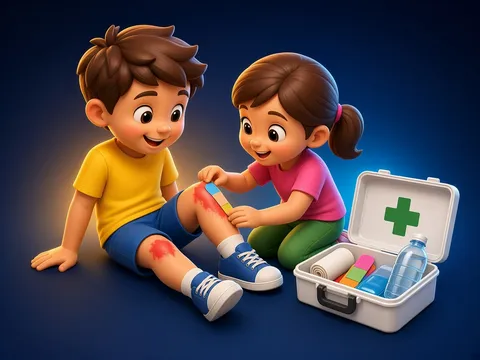
First aid is simple help given before a doctor arrives. The most important rule: stay calm and tell an adult. For a small cut or graze: wash your hands, rinse the wound with clean water and cover it with a clean bandage or plaster. For a minor burn: hold it under cool running water for a long time (about 20 minutes); don’t put ice, butter or toothpaste on it. For a nosebleed: sit down, lean your head slightly forward, pinch the soft part of your nose and breathe through your mouth. In a serious emergency adults call for help: in Azerbaijan the ambulance is 103, fire 101, police 102 and the Emergency Situations service 112.
 What the book shows

The textbook usually gives a big picture, questions and a small observation or project task. Talk about the picture, link the questions to everyday life and carry on the observation at home.
Textbook link:
This is not the textbook’s text but a short description of the topic. Check the exact page in your own textbook.
 The lesson step by step
- 1
Warm-up5 min
What happened?
- 2
New topic10 min
Stay calm, tell an adult.
- 3
Practice10 min
Cuts and burns.
- 4
Game10 min
Nosebleeds.
- 5
Wrap-up5 min
Practising an emergency call.
 Let’s understand
For the student Simple language
| What happened? | What we do | What we don’t do |
|---|---|---|
| 🩹 cut, graze | rinse it, cover with a clean dressing | don’t touch with dirty hands |
| 🔥 minor burn | hold under cool running water | no ice, butter or toothpaste |
| 👃 nosebleed | sit, lean forward, pinch the nose | don’t tip the head back |
 For the parent
How to help
- Look through your home first-aid kit together.
- Practise saying the emergency numbers and your home address from memory.
 For the teacher
 Lesson goals
- Know what to do for a small cut, graze, minor burn and nosebleed, remember emergency numbers, and always tell an adult.
How to teach it
- Observation, picture talk, group work, mini-project
 Differentiation
- Weaker pupils: with pictures and cards; stronger pupils: find an extra fact and tell the class
 Questions for the class
- How can we help with a small injury?
 How to check
The pupil gives the right steps for cuts, burns and nosebleeds and knows the emergency numbers.
 Scientific Scientific language
Why not tip the head back?
Blood runs down the throat, gets swallowed and can make you feel sick.
Why not ice?
Ice can hurt damaged skin even more; cool water is safer.
Self-study
Step by step
- I stay calm and tell an adult.
- Cut: rinse and cover.
- Burn: cool water.
- Nose: lean forward and pinch.
- I know 103.
Going deeper
 Scientific language: for older students, parents and teachers.
Knowing your address by heart is part of first aid: the first question on an emergency call is “Where are you?”.
 Play and check
Right or wrong?
 How to write it down
- Draw a first-aid kit and list 5 things in it.
- Write down the emergency numbers.
How the classwork looks in the notebook
Sample: the date and heading follow this country’s notebook rules.
 Watch out: common mistakes
 Where it helps in life
- Safety at home and outside
- Fire safety
 At home
Core
- Check the first-aid kit with your family.
Extra ⭐
- Write what you would say on an emergency call: your name, address and what happened.
How to do it
- Observe at home or talk with an adult.
- Write or draw what you found.
Answers for parents
For example: “My name is Aylin. Our address is … Street, house … My grandmother has fallen and can’t get up.” Don’t hang up until the operator says so.
Step-by-step homework solution — Show the solution (try it yourself first)
Think
- Your friend grazes a knee. Stay calm, tell an adult, rinse the graze with clean water and cover it with a clean dressing.
How the homework looks in the notebook
Sample: the date and heading follow this country’s notebook rules.

 About cookies