


How we get information: the five senses


 About this lesson
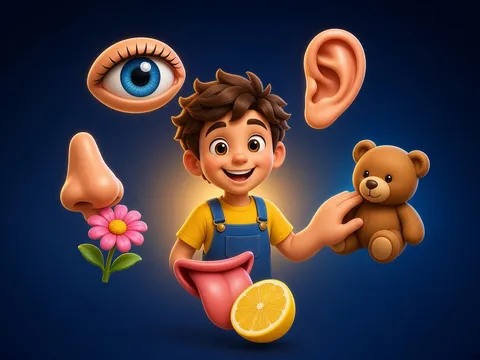
The five senses: sight (eyes) for colour and shape; hearing (ears) for sounds and music; smell (nose) for scents and smoke; taste (tongue) for sweet, sour, salty and bitter; touch (skin) for warm, cold, soft and hard. Most information comes through our eyes and ears. Some information comes from one sense only: your tongue tells you a lemon is sour.
 What the book shows

In computer science the child first learns to think through unplugged games: recognising information, ordering steps and learning safety rules.
Textbook link:
This is not the textbook’s text but a short description of the topic. Check the exact page in your own textbook.
 The lesson step by step
- 1
Warm-up5 min
Feely bag.
- 2
New topic10 min
Five senses.
- 3
Practice10 min
Sort by sense.
- 4
Game10 min
Blindfold game.
- 5
Wrap-up5 min
Senses diary.
 Let’s understand
For the student Simple language
| Sense | Organ | What we learn |
|---|---|---|
| 👁️ sight | eyes | colour, shape, size |
| 👂 hearing | ears | sound, music |
| 👃 smell | nose | scents, smoke |
| 👅 taste | tongue | sweet, sour, salty, bitter |
| ✋ touch | skin | warm, cold, soft |
 For the parent
How to help
- Play a blindfold game: guess things by touch and fruit by smell.
- Find the 4 tastes in the kitchen together.
 For the teacher
 Lesson goals
- Know the five senses and the information each gives; explain that most information comes through sight and hearing.
How to teach it
- Unplugged games, cards, role play, discussion
 Differentiation
- Weaker pupils: 2–3 steps; stronger pupils build their own algorithm
 Questions for the class
- What are the five senses and what does each tell us?
 How to check
The pupil matches 6 examples to the right sense.
 Scientific Scientific language
Danger signals
The smell of smoke, a loud alarm, pain from a hot stove: our senses protect us.
Working together
With a blocked nose food tastes weaker, because taste and smell work together.
Self-study
Step by step
- Which sense helps?
- Which organ?
- What did I learn?
- Is it safe? (Never taste unknown things!)
Going deeper
 Scientific language: for older students, parents and teachers.
Blind people read Braille with their fingers, getting information through touch.
 Play and check
Which sense gives this information?
 How to write it down
- Draw five small pictures for the five senses and write 2 facts for each.
How the classwork looks in the notebook
Sample: the date and heading follow this country’s notebook rules.
 Watch out: common mistakes
 Where it helps in life
- Coding information
- Devices that help our senses
 At home
Core
- At breakfast write one fact from each sense.
Extra ⭐
- Blindfolded, guess 3 things by touch.
How to do it
- Do the task with a grown-up.
- Explain in words what you noticed.
Answers for parents
For example: sight — the tea is reddish; hearing — the kettle whistles; smell — the bread smells good; taste — the honey is sweet; touch — the glass is hot.
Step-by-step homework solution — Show the solution (try it yourself first)
Think
- I smell smoke: I tell an adult straight away, because my sense of smell warned me.
How the homework looks in the notebook
Sample: the date and heading follow this country’s notebook rules.

 About cookies