


A box from a cube net


 About this lesson
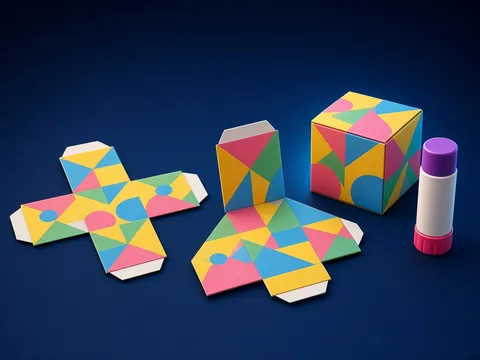
A cube has 6 equal square faces. If we “unfold” a cube and lay it flat, we get a net, for example a cross shape of 6 squares. To glue it we add tabs, small trapezium strips, to some edges. Before folding we score the fold lines with a ruler and the blunt side of the scissors so they fold neatly. Then we put a little glue on each tab and press it to the next face.
 What the book shows

In technology lessons the child works with their hands: cutting, folding, gluing and making things from natural materials. Every task starts with a safety rule.
Textbook link:
This is not the textbook’s text but a short description of the topic. Check the exact page in your own textbook.
 The lesson step by step
- 1
Warm-up5 min
Unfolding a box.
- 2
New topic10 min
What is a net?
- 3
Practice10 min
Drawing and cutting.
- 4
Game10 min
Folding and gluing.
- 5
Wrap-up5 min
Decorating cubes.
 Let’s understand
For the student Simple language
| Step | What we do |
|---|---|
| 1 | ▦ draw a cross of 6 squares on squared paper (each 4×4 squares) |
| 2 | 🔖 add glue tabs to the edges |
| 3 | ✂️ cut out, 📏 score the fold lines |
| 4 | 📦 fold up and glue the tabs |
 For the parent
How to help
- Unfold an empty cardboard box at home and look at its net.
- Turn the finished cube into a dice or a gift box.
 For the teacher
 Lesson goals
- Recognise a cube net, draw it on squared paper, add glue tabs, then fold and glue it into a cube box.
How to teach it
- Demonstration, step-by-step making, pair work, a display
 Differentiation
- Weaker pupils work from a ready outline; stronger pupils make their own design
 Questions for the class
- How do we make a cube from flat paper?
 How to check
The pupil draws the net, places the tabs correctly and assembles a neat cube.
 Scientific Scientific language
A cube has many nets
There are 11 different cube nets; the cross is just one.
Why score the folds?
Scoring crushes the paper fibres along the line, so the paper bends neatly right there.
Self-study
Step by step
- Are the 6 squares equal?
- Are the tabs in the right places?
- Are the folds scored?
- Did I use only a little glue?
Going deeper
 Scientific language: for older students, parents and teachers.
Many cardboard boxes are cut flat as nets in a factory and folded later, which makes them easy to transport.
 Play and check
Will it fold into a cube?
 How to write it down
- Draw two different cube nets on squared paper.
- Colour where the tabs go.
How the classwork looks in the notebook
Sample: the date and heading follow this country’s notebook rules.
 Watch out: common mistakes
 Where it helps in life
- Nets of prisms and pyramids
- A paper town model
 At home
Core
- Make a cube and decorate its faces (for example as a dice).
Extra ⭐
- Unfold a small box and draw its net: how many faces does it have?
How to do it
- Work with a grown-up watching.
- Tidy up afterwards.
Answers for parents
A cube has 6 faces. A tea or toothpaste box also has 6 faces, but they are rectangles, not squares; it is a cuboid.
Step-by-step homework solution — Show the solution (try it yourself first)
Calculate
- Each face is 4×4 = 16 squares. 6 faces: 6 × 16 = 96 squares.
How the homework looks in the notebook
Sample: the date and heading follow this country’s notebook rules.

 About cookies