


Book illustration

 About this lesson
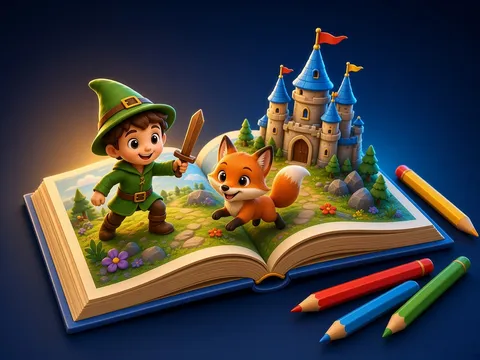
An illustration is a picture drawn for a book’s text; the artist is an illustrator. It shows what happens and how the characters look and feel, helping readers imagine. For a good illustration we read carefully: what is the hero like, where and when does it happen? We choose the most exciting, decisive moment. We make the hero bigger and brighter so the eye goes there first. A cover shows the title, the author and a main image that sums up the story. Pictures in children’s books are usually bright and clear.
 What the book shows

In art lessons the child explores colour, line and shape, draws and creates patterns. Look at the textbook examples, then make your own work.
Textbook link:
This is not the textbook’s text but a short description of the topic. Check the exact page in your own textbook.
 The lesson step by step
- 1
Warm-up5 min
Book pictures.
- 2
New topic10 min
Reading the text.
- 3
Practice10 min
The key moment.
- 4
Game10 min
Illustrating.
- 5
Wrap-up5 min
The cover.
 Let’s understand
For the student Simple language
| Question | Example (“The Gingerbread Man”) |
|---|---|
| Who is the hero, what is he like? | a cheeky, fast gingerbread man |
| Where? | by a river |
| Which moment? | meeting the fox |
| Mood? | tense, exciting |
 For the parent
How to help
- Look at the pictures in a favourite book together: which moments did the artist choose?
- Read a story aloud and let your child draw one scene.
 For the teacher
 Lesson goals
- Explain how an illustration supports the text, choose a key scene from a story, and draw an illustration and a cover.
How to teach it
- Observation, drawing, colour mixing, a class display
 Differentiation
- Weaker pupils colour a ready outline; stronger pupils create their own composition
 Questions for the class
- How does a picture add to a text?
 How to check
The pupil chooses a matching scene, shows the hero clearly and makes a cover.
 Scientific Scientific language
Words and pictures
In picture books there are more pictures than words.
Colour and mood
Dark, cool colours feel scary; warm, bright ones feel happy.
Self-study
Step by step
- I read the text carefully.
- I picked the most exciting moment.
- The hero is big and clear.
- The colours match the mood.
Going deeper
 Scientific language: for older students, parents and teachers.
Different illustrators can draw the same tale completely differently: each imagines the hero in their own way.
 Play and check
What mood do the colours create?
 How to write it down
- Pick a scene from a favourite tale and sketch it.
- Draw a cover: title, author, main image.
How the classwork looks in the notebook
Sample: the date and heading follow this country’s notebook rules.
 Watch out: common mistakes
 Where it helps in life
- Architecture of Azerbaijan
- Graphic art and posters
 At home
Core
- Illustrate a poem or fairy tale.
Extra ⭐
- Make your own 4-page mini book with a cover.
How to do it
- Prepare a quiet spot and materials.
- Show your work to a grown-up and explain it.
Answers for parents
Check: the picture matches the text, shows a key moment, the hero is clear, and the cover has a title, author and image.
Step-by-step homework solution — Show the solution (try it yourself first)
Think
- In the story the hero gets lost in a forest at night. A dark blue background, a big hero and a small light far away let readers feel both fear and hope.
How the homework looks in the notebook
Sample: the date and heading follow this country’s notebook rules.

 About cookies