


Ceramics and embroidery


 About this lesson
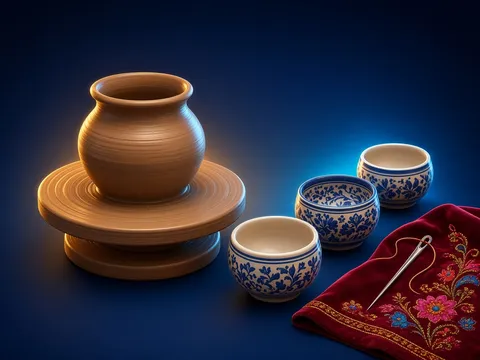
Decorative art means decorating things we use every day: dishes, clothes, carpets, household items. Ceramics are made from clay: the potter shapes clay on a potter’s wheel, dries it, then fires it in a special kiln at a high temperature so it hardens. Then the piece is painted and coated with glaze to make it shiny. Tekelduz is an ancient Azerbaijani embroidery art: patterns are stitched in silk thread on velvet or woollen cloth; Shaki embroidery is especially famous. The patterns feature flowers, leaves, birds and geometric shapes, usually repeated and symmetrical.
 What the book shows

In art lessons the child explores colour, line and shape, draws and creates patterns. Look at the textbook examples, then make your own work.
Textbook link:
This is not the textbook’s text but a short description of the topic. Check the exact page in your own textbook.
 The lesson step by step
- 1
Warm-up5 min
Patterns at home.
- 2
New topic10 min
Ceramics.
- 3
Practice10 min
Embroidery.
- 4
Game10 min
Making patterns.
- 5
Wrap-up5 min
Mini-exhibition.
 Let’s understand
For the student Simple language
| 🏺 Ceramics | 🪡 Embroidery | |
|---|---|---|
| Material | clay | velvet, wool cloth, silk thread |
| Maker | potter | embroiderer |
| Steps | shape → dry → fire → decorate | transfer pattern → stitch → finish |
| Patterns | flowers, lines, geometry | flowers, birds, the boteh |
 For the parent
How to help
- Look at patterned dishes, carpets and embroidery at home: which shapes repeat?
- Make a small bowl from clay or salt dough together.
 For the teacher
 Lesson goals
- Know that decorative art is both useful and beautiful, explain how ceramics and embroidery are made, and create your own pattern.
How to teach it
- Observation, drawing, colour mixing, a class display
 Differentiation
- Weaker pupils colour a ready outline; stronger pupils create their own composition
 Questions for the class
- How do everyday objects become works of art?
 How to check
The pupil explains how ceramics and embroidery are made and creates a rhythmic, symmetrical pattern.
 Scientific Scientific language
Why fire clay?
Unfired clay goes soft in water; after firing at high heat it is hard as stone.
The boteh
The almond-shaped boteh pattern is very common in Azerbaijani carpets and embroidery.
Self-study
Step by step
- The object is useful and beautiful.
- The pattern repeats.
- It is symmetrical.
- I can list the steps in order.
Going deeper
 Scientific language: for older students, parents and teachers.
Craft patterns pass from generation to generation: embroidery and dishes handed from grandparent to grandchild keep a family’s memory.
 Play and check
Ceramics or embroidery?
 How to write it down
- Draw a bowl outline and decorate it with a repeating pattern.
- Draw a symmetrical flower pattern for embroidery.
How the classwork looks in the notebook
Sample: the date and heading follow this country’s notebook rules.
 Watch out: common mistakes
 Where it helps in life
- Carpet weaving
- Metal engraving
 At home
Core
- Make a small dish from clay or salt dough and decorate it.
Extra ⭐
- Do a safe “embroidery” on card: thread wool through punched holes.
How to do it
- Prepare a quiet spot and materials.
- Show your work to a grown-up and explain it.
Answers for parents
Check: the dish is sturdy and the pattern repeats symmetrically; the wool follows the pattern lines in order.
Step-by-step homework solution — Show the solution (try it yourself first)
Think
- Drawing the same leaf 8 times evenly round a bowl’s rim makes a rhythmic pattern that the eye follows round the circle.
How the homework looks in the notebook
Sample: the date and heading follow this country’s notebook rules.

 About cookies