


What history studies


 About this lesson
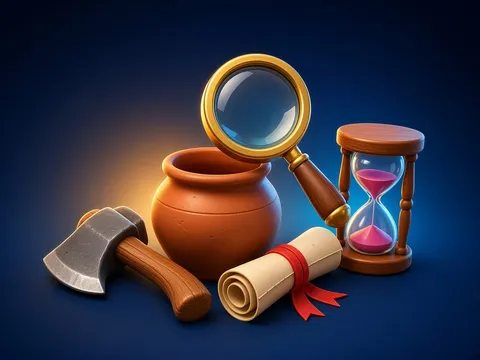
History is the science of the past of people and society. Historians learn about the past from historical sources, which fall into three groups: material sources (tools, pots, weapons, buildings, coins), written sources (inscriptions, manuscripts, documents, chronicles) and oral sources (legends, epics, traditions, folk songs). The science that searches for and studies ancient objects in the ground is archaeology, and this work is called excavation. Chronology is used to count time. A hundred years make a century and a thousand years a millennium. Centuries are usually written in Roman numerals: the 21st century is XXI. In many countries time is divided into BC (before our era) and AD (our era). BC years count backwards: 300 BC was earlier than 200 BC. A timeline shows events in order. History helps us know our people’s past and learn from it.
 What the book shows

In grade 5 the History of Azerbaijan course begins with an introduction to history and briefly covers the country’s past from ancient times to today: the oldest human sites, ancient states, the Middle Ages, the khanates, the Democratic Republic and the restoration of independence. Read the topic in the textbook, look at the maps and pictures, and write the dates in your notebook.
Textbook link:
This is not the textbook’s text but a short description of the topic. Check the exact page in your own textbook.
 The lesson step by step
- 1
Warm-up5 min
A mystery object: what is it and how old?
- 2
New topic10 min
What history studies.
- 3
Practice10 min
Kinds of sources.
- 4
Game10 min
Centuries and eras.
- 5
Wrap-up5 min
Drawing a timeline.
 Let’s understand
For the student Simple language
| Source | Example | Who studies it? |
|---|---|---|
| material | a pot, a tool, a coin | archaeologist |
| written | an inscription, a manuscript | historian |
| oral | a legend, an epic | folklorist |
 For the parent
How to help
- Look at old family items (photos, documents, medals) together: what kind of source is each, and what does it tell us?
 For the teacher
 Lesson goals
- Know that history is the science of humanity’s past, tell kinds of historical sources apart, count centuries and eras, and place events on a timeline.
How to teach it
- Working with sources and maps, timelines, discussion, mini-project
 Differentiation
- Weaker pupils work with key dates and pictures; stronger pupils compare sources and write their own conclusion
 Questions for the class
- How do we learn about the past?
 How to check
The pupil tells sources apart, finds the century of a year correctly and puts events in order on a timeline.
 Scientific Scientific language
How to find the century
Add 1 to the first two digits: 1918 → 19 + 1 = the 20th century.
An archaeologist’s tools
A spade, a brush, a tape measure and a notebook — the exact place of every find must be recorded.
Self-study
Step by step
- I explained what history studies.
- I told the kinds of sources apart.
- I worked out the century.
- I drew a timeline.
Going deeper
 Scientific language: for older students, parents and teachers.
The National Museum of History of Azerbaijan is in Baku and holds thousands of objects from different periods.
 Play and check
Which kind of source is it?
 How to write it down
- Draw your family timeline with 5 events.
- Write which century 1828, 1918 and 1991 belong to.
How the classwork looks in the notebook
Sample: the date and heading follow this country’s notebook rules.
 Watch out: common mistakes
 Where it helps in life
- Azykh Cave: the oldest human site
 At home
Core
- Find an old object at home and write 4–5 sentences: what it is, how old it is and what it tells us.
Extra ⭐
- Choose 5 dates and write their centuries.
How to do it
- Read the topic in the textbook.
- Write the key dates and names in your notebook and add them to your timeline.
Answers for parents
1828 — 19th century; 1918 — 20th; 1991 — 20th; 2025 — 21st.
Step-by-step homework solution — Show the solution (try it yourself first)
Think
- A historian finds both a document and a legend about the same event. Which is more reliable? Usually a document written at the time is more exact, while a legend shows how the people felt about the event. Historians compare sources to get closer to the truth.
How the homework looks in the notebook
Sample: the date and heading follow this country’s notebook rules.

 About cookies