


Azykh Cave: the oldest human site


 About this lesson
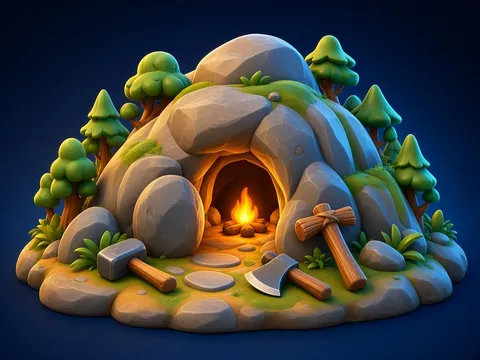
Azykh Cave is a many-layered Palaeolithic site in the Khojavend district of Azerbaijan, in the valley of the Guruchay river. Excavations began in 1960 under the archaeologist Mammadali Huseynov. In 1968 a fragment of an ancient human lower jaw was found there; this early human was named Azykhanthropus (Azykh man). Scientists estimate the find at about 350–400 thousand years old, and the cave’s lowest layers are even older. Azykh is considered one of the oldest human sites in Europe and the Caucasus, showing that Azerbaijan was one of the lands where people settled early. Many stone tools, bones of hunted animals and remains of hearths have been found, which shows that people used fire. Early people lived by hunting and gathering (collecting fruit, roots and seeds), lived in small groups and sheltered in caves from the cold and wild animals. Fire was vital for warmth, cooking and scaring animals away. Other ancient cave sites in Azerbaijan include Taghlar, Damjili and Dashsalahli.
 What the book shows

In grade 5 the History of Azerbaijan course begins with an introduction to history and briefly covers the country’s past from ancient times to today: the oldest human sites, ancient states, the Middle Ages, the khanates, the Democratic Republic and the restoration of independence. Read the topic in the textbook, look at the maps and pictures, and write the dates in your notebook.
Textbook link:
This is not the textbook’s text but a short description of the topic. Check the exact page in your own textbook.
 The lesson step by step
- 1
Warm-up5 min
A fire in a cave: who lit it?
- 2
New topic10 min
Azykh Cave and its discovery.
- 3
Practice10 min
What the finds tell us.
- 4
Game10 min
How early people lived.
- 5
Wrap-up5 min
The story of one day.
 Let’s understand
For the student Simple language
| Find | What it tells us |
|---|---|
| a jaw fragment | very early people lived here |
| stone tools | they hunted, cut and pounded |
| hearth remains | they used fire |
| animal bones | they lived by hunting |
 For the parent
How to help
- Talk together: how would we live with no electricity, dishes or shops? What would be hard without fire?
 For the teacher
 Lesson goals
- Know where Azykh Cave is and why it matters, list its main finds, and explain how early people lived (hunting, gathering, using fire).
How to teach it
- Working with sources and maps, timelines, discussion, mini-project
 Differentiation
- Weaker pupils work with key dates and pictures; stronger pupils compare sources and write their own conclusion
 Questions for the class
- Why is Azykh Cave important for Azerbaijan’s history?
 How to check
The pupil gives the cave’s location and main finds, says what they show, and explains how early people lived.
 Scientific Scientific language
What is the Palaeolithic?
It means “Old Stone Age”, when people shaped tools from stone.
Layers
Soil builds up in layers in a cave: lower layers are older, upper ones newer.
Self-study
Step by step
- I said where Azykh is.
- I listed the main finds.
- I explained how early people lived.
- I said why fire mattered.
Going deeper
 Scientific language: for older students, parents and teachers.
Archaeologists date finds in several ways: by the depth of the layer, by the kinds of animal bones and by special laboratory tests.
 Play and check
Was it part of early people’s lives?
 How to write it down
- Write 3 facts about Azykh Cave.
- Describe a day in an early human’s life in 5 sentences.
How the classwork looks in the notebook
Sample: the date and heading follow this country’s notebook rules.
 Watch out: common mistakes
 Where it helps in life
- History on the rocks: Gobustan
 At home
Core
- Make a fact sheet on Azykh Cave: location, finds, importance and a picture.
Extra ⭐
- Draw a stone tool and write what it was used for.
How to do it
- Read the topic in the textbook.
- Write the key dates and names in your notebook and add them to your timeline.
Answers for parents
Facts: Khojavend district, Guruchay valley; excavations from 1960 led by M. Huseynov; 1968 — the Azykhanthropus jaw fragment; hearth remains show fire use.
Step-by-step homework solution — Show the solution (try it yourself first)
Think
- Why did early people choose caves? A cave kept off rain, wind and cold, and a fire at the entrance kept wild animals away. A river nearby meant water and game. It is no accident that Azykh lies in the Guruchay valley.
How the homework looks in the notebook
Sample: the date and heading follow this country’s notebook rules.

 About cookies