


History on the rocks: Gobustan


 About this lesson
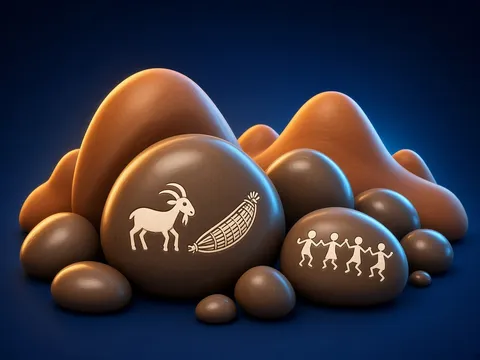
Gobustan is a land of ancient monuments south-west of Baku, near the Caspian shore. Its rocks bear thousands of carvings (petroglyphs) made over many periods, from the Stone Age to much later centuries. The archaeologist Isaak Jafarzade did major work studying them. In 2007 the Gobustan Rock Art Cultural Landscape was added to the UNESCO World Heritage List. The carvings show hunters, people with bows, goats, deer, bulls, boats, and people dancing hand in hand, which recalls the folk dance yalli. The boats show that ancient people sailed the sea. Gobustan has the “gaval stone”: tap it with a pebble and it rings like a frame drum. A 1st-century Latin inscription left by a Roman legion was also found here, one of the easternmost Latin inscriptions known. The rock carvings are a stone “book” about people’s beliefs, work and lives from a time before writing.
 What the book shows

In grade 5 the History of Azerbaijan course begins with an introduction to history and briefly covers the country’s past from ancient times to today: the oldest human sites, ancient states, the Middle Ages, the khanates, the Democratic Republic and the restoration of independence. Read the topic in the textbook, look at the maps and pictures, and write the dates in your notebook.
Textbook link:
This is not the textbook’s text but a short description of the topic. Check the exact page in your own textbook.
 The lesson step by step
- 1
Warm-up5 min
A picture on a rock: who made it?
- 2
New topic10 min
Where Gobustan is.
- 3
Practice10 min
“Reading” the carvings.
- 4
Game10 min
The gaval stone and the Roman inscription.
- 5
Wrap-up5 min
Our own petroglyph.
 Let’s understand
For the student Simple language
| Carving | What it shows |
|---|---|
| hunters with bows | hunting |
| boats | sailing the sea |
| a hand-in-hand dance | festivals, the yalli dance |
| animals | hunting and herding |
 For the parent
How to help
- Draw a day in your family’s life in pictures only, without words: can someone else “read” your rock art?
 For the teacher
 Lesson goals
- Know where Gobustan is and why it matters, list the subjects of its rock carvings, and draw conclusions about ancient life from them.
How to teach it
- Working with sources and maps, timelines, discussion, mini-project
 Differentiation
- Weaker pupils work with key dates and pictures; stronger pupils compare sources and write their own conclusion
 Questions for the class
- What do rock carvings tell us?
 How to check
The pupil gives Gobustan’s location and importance, lists the carvings’ subjects and draws conclusions about ancient life.
 Scientific Scientific language
How was a petroglyph made?
By pecking or scratching the rock face with a hard stone.
Mud volcanoes
There are many mud volcanoes near Gobustan, and Azerbaijan is known worldwide for them.
Self-study
Step by step
- I said where Gobustan is.
- I listed the subjects.
- I drew conclusions.
- I knew it is a UNESCO site.
Going deeper
 Scientific language: for older students, parents and teachers.
Gobustan has an open-air museum reserve where visitors can see the carvings up close.
 Play and check
Which activity does the carving tell us about?
 How to write it down
- Draw 3 Gobustan carvings and write what each shows.
- Write 3 facts about Gobustan.
How the classwork looks in the notebook
Sample: the date and heading follow this country’s notebook rules.
 Watch out: common mistakes
 Where it helps in life
- Caucasian Albania
 At home
Core
- Write a 5–6 sentence tourist guide to Gobustan.
Extra ⭐
- Draw your own “petroglyph”: 3 symbols showing life today.
How to do it
- Read the topic in the textbook.
- Write the key dates and names in your notebook and add them to your timeline.
Answers for parents
Facts: south-west of Baku; thousands of carvings; studied by I. Jafarzade; UNESCO 2007; the gaval stone; the Roman inscription.
Step-by-step homework solution — Show the solution (try it yourself first)
Think
- Before writing, how did people share information? With pictures! A hunting scene carved in rock may have been a wish for a good hunt or a memory of an event. Reading them, we “talk” with people from thousands of years ago.
How the homework looks in the notebook
Sample: the date and heading follow this country’s notebook rules.

 About cookies