


Folk tales


 About this lesson
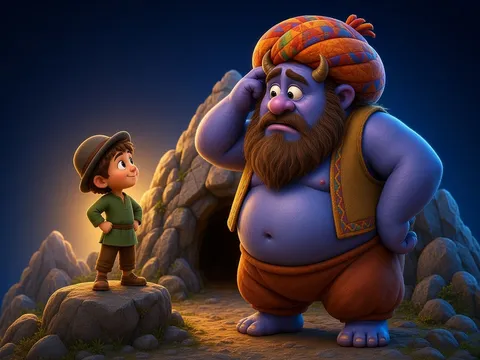
The folk tale is the best-loved genre of folk literature. Its events are invented, and the listener knows it. There are three kinds: animal tales (animals talk like people; the fox is cunning, the wolf greedy), magic tales (giants called divs, dragons, magic objects and the hero’s hard journey, as in “Malikmammad”) and everyday tales (about ordinary people, where wit and quick thinking win). Features: the opening “Biri vardı, biri yoxdu” (once there was and once there wasn’t); events repeated three times (three brothers, three tests); magical helpers; good beating evil; and a happy ending, often closing with “three apples fell from the sky”. In “Jirtdan” a tiny but clever boy beats a huge, strong div with his wits: the tale shows that brains beat strength.
 What the book shows

In grade 5 literature lessons pupils learn that literature is the art of words and meet folk literature (legends, tales), poems, fables, short stories and classical poetry. Read the work in the textbook first, then answer the questions and write your own opinion.
Textbook link:
This is not the textbook’s text but a short description of the topic. Check the exact page in your own textbook.
 The lesson step by step
- 1
Warm-up5 min
A tiny boy and a giant.
- 2
New topic10 min
What is a folk tale?
- 3
Practice10 min
Kinds of tale.
- 4
Game10 min
Features of tales.
- 5
Wrap-up5 min
Building our own tale.
 Let’s understand
For the student Simple language
| Kind | Characters | Example |
|---|---|---|
| animal tale | fox, wolf, hare | «Tıq-tıq xanım» |
| magic tale | div, dragon, hero | «Məlikməmməd» |
| everyday tale | ordinary people | a quick-witted villager |
 For the parent
How to help
- Tell your child a tale you heard as a child, then let them find its kind and features.
 For the teacher
 Lesson goals
- Know the kinds of folk tale (animal, magic, everyday) and their features (opening formula, the rule of three, magic, a happy ending), describe the hero, and retell a tale from a plan.
How to teach it
- Expressive reading, text questions, character analysis, reading in parts, creative writing
 Differentiation
- Weaker pupils retell with a plan and key words; stronger pupils write their own text
 Questions for the class
- What do folk tales teach us?
 How to check
The pupil identifies a tale’s kind and features, describes the hero and retells it from a plan.
 Scientific Scientific language
Why three?
Repeating things three times helps listeners remember and builds suspense: the third time the hero wins.
Everywhere
Similar tale plots exist among many peoples, each adapting them to its own life.
Self-study
Step by step
- I named the kinds of tale.
- I found its features.
- I described the hero.
- I retold a tale from a plan.
Going deeper
 Scientific language: for older students, parents and teachers.
Azerbaijani tales were collected and printed in the 19th and 20th centuries, and folklorists still record new versions in villages today.
 Play and check
Which kind of tale?
 How to write it down
- Write a 5-point plan of a tale you know.
- Write 3 qualities of the main hero with examples.
How the classwork looks in the notebook
Sample: the date and heading follow this country’s notebook rules.
 Watch out: common mistakes
 Where it helps in life
- Love of homeland in poetry
 At home
Core
- Retell “Jirtdan” to your family from a plan.
Extra ⭐
- Write your own tale with an opening formula, three tests and a happy ending.
How to do it
- Read the work aloud.
- Copy your favourite part and explain why you chose it.
Answers for parents
Check: the tale opens with the formula, the hero passes three tests, good wins and there is a closing formula.
Step-by-step homework solution — Show the solution (try it yourself first)
Think
- In tales the villain is often big and strong, the hero small and weak. The people show that wits, courage and kindness win, not size.
How the homework looks in the notebook
Sample: the date and heading follow this country’s notebook rules.

 About cookies