


Fables


 About this lesson
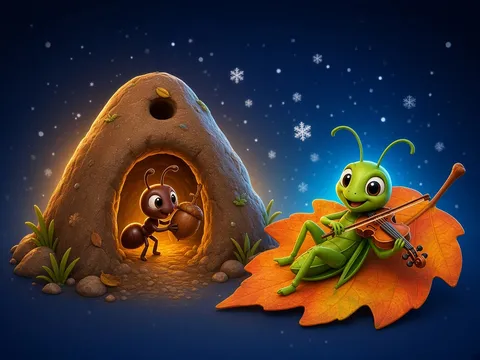
A fable is a short work with a lesson, in verse or prose. Animals, birds, plants and objects speak and act like people, but really they show human traits: the fox is cunning, the wolf cruel, the ant hard-working, the donkey stubborn. Showing one thing through another image is called allegory. At the end or start of a fable there is a short conclusion stating the main idea: the moral. The oldest master of the fable is said to be Aesop of ancient Greece; later La Fontaine in France and Krylov in Russia wrote fables. In Aesop’s “The Grasshopper and the Ant” the ant stores food all summer while the grasshopper sings and plays; when winter comes the grasshopper goes hungry. Moral: whoever works in good time will not be stuck on a hard day. Azerbaijani poets have also written and translated fables.
 What the book shows

In grade 5 literature lessons pupils learn that literature is the art of words and meet folk literature (legends, tales), poems, fables, short stories and classical poetry. Read the work in the textbook first, then answer the questions and write your own opinion.
Textbook link:
This is not the textbook’s text but a short description of the topic. Check the exact page in your own textbook.
 The lesson step by step
- 1
Warm-up5 min
The ant and the grasshopper.
- 2
New topic10 min
What is a fable?
- 3
Practice10 min
Allegory.
- 4
Game10 min
Finding the moral.
- 5
Wrap-up5 min
Reading in parts.
 Let’s understand
For the student Simple language
| Character | Trait |
|---|---|
| fox | cunning |
| wolf | cruelty |
| ant | hard work |
| grasshopper | carelessness |
 For the parent
How to help
- Read a fable together and ask: “Which kind of person is this animal like? What do we learn from it?”
 For the teacher
 Lesson goals
- Know that a fable is a short work with a lesson in which animals or objects stand for human traits (allegory), and find and explain its moral in your own words.
How to teach it
- Expressive reading, text questions, character analysis, reading in parts, creative writing
 Differentiation
- Weaker pupils retell with a plan and key words; stronger pupils write their own text
 Questions for the class
- What does a short animal story tell us about people?
 How to check
The pupil recognises a fable, identifies the traits the characters show and explains the moral in their own words.
 Scientific Scientific language
Why animals?
Showing a bad trait through an animal, without naming a person, is both interesting and less hurtful.
Aesopian language
Saying something in a hidden, allegorical way is called “Aesopian language”.
Self-study
Step by step
- I said what a fable is.
- I found the trait a character stands for.
- I explained the moral.
- I understood allegory.
Going deeper
 Scientific language: for older students, parents and teachers.
The same plot recurs with different characters: in Aesop it is a grasshopper, in Krylov a dragonfly that asks the ant for help.
 Play and check
Which trait does the character show?
 How to write it down
- Retell “The Grasshopper and the Ant” in 4 sentences.
- Write the moral in your own words with a real-life example.
How the classwork looks in the notebook
Sample: the date and heading follow this country’s notebook rules.
 Watch out: common mistakes
 Where it helps in life
- A story and its hero
 At home
Core
- Read a fable in parts with your family.
Extra ⭐
- Write your own fable: two animals, one event and a moral at the end.
How to do it
- Read the work aloud.
- Copy your favourite part and explain why you chose it.
Answers for parents
Check: there are two animal characters, each showing a human trait; the event is short; a clear moral ends the fable.
Step-by-step homework solution — Show the solution (try it yourself first)
Think
- In winter the grasshopper asks the ant for help. What would you do if you were the ant? The moral teaches working in good time, yet a kind person might still help someone in need, which is worth thinking about too.
How the homework looks in the notebook
Sample: the date and heading follow this country’s notebook rules.

 About cookies