


A story and its hero

 About this lesson
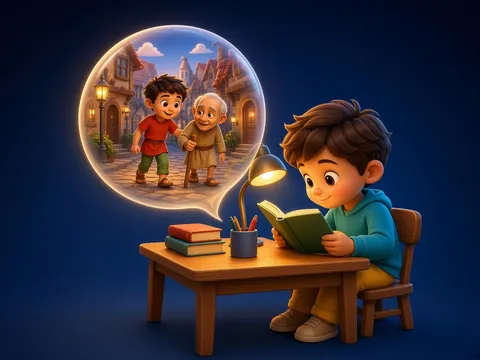
A short story is a prose work that briefly describes one or a few events from life; it belongs to the epic kind and has a known author. It has few characters and its events happen over a short time. To analyse it we use these ideas: the theme is what it is about (friendship, work, family); the idea is the main thought the author wants to share (a friend in need is a friend indeed); the plot is the order of events: opening, development, the most tense moment (climax) and ending. The hero is a person in the work. To describe the main hero we look at their actions, words, attitude to others and how the author describes them. If the hero helps an old man cross the street, it shows they are kind and attentive. We always support our view with an example from the text.
 What the book shows

In grade 5 literature lessons pupils learn that literature is the art of words and meet folk literature (legends, tales), poems, fables, short stories and classical poetry. Read the work in the textbook first, then answer the questions and write your own opinion.
Textbook link:
This is not the textbook’s text but a short description of the topic. Check the exact page in your own textbook.
 The lesson step by step
- 1
Warm-up5 min
A child reading and imagining.
- 2
New topic10 min
What is a short story?
- 3
Practice10 min
Theme, idea and plot.
- 4
Game10 min
Describing the hero.
- 5
Wrap-up5 min
Writing our own story.
 Let’s understand
For the student Simple language
| Term | Question |
|---|---|
| theme | What is it about? |
| idea | What does the author want to say? |
| plot | How do events unfold? |
| hero | What is the hero like, and why? |
 For the parent
How to help
- Ask about the hero of a story your child has read: “What did they do? What would you have done in their place?”
 For the teacher
 Lesson goals
- Know that a short story is a small prose work of the epic kind, identify its theme, idea, plot and hero, and describe the hero from their actions and words.
How to teach it
- Expressive reading, text questions, character analysis, reading in parts, creative writing
 Differentiation
- Weaker pupils retell with a plan and key words; stronger pupils write their own text
 Questions for the class
- How do we know what a hero is like?
 How to check
The pupil identifies a story’s theme, idea and plot and describes the hero with evidence from the text.
 Scientific Scientific language
Versus a tale
A story has no magic, its events are lifelike and its author is known.
Detail
A writer can reveal character through a small detail, a look or a gesture.
Self-study
Step by step
- I named the theme.
- I explained the idea.
- I showed the parts of the plot.
- I described the hero with evidence from the text.
Going deeper
 Scientific language: for older students, parents and teachers.
In Azerbaijani literature writers such as Jalil Mammadguluzadeh, Abdulla Shaig and Suleyman Sani Akhundov wrote many stories for and about children.
 Play and check
Which part of the plot?
 How to write it down
- Fill in a table with the theme, idea and hero of a story you read.
- Give 3 of the hero’s qualities with examples from the text.
How the classwork looks in the notebook
Sample: the date and heading follow this country’s notebook rules.
 Watch out: common mistakes
 Where it helps in life
- Nizami Ganjavi: the old brickmaker
 At home
Core
- Write a short story (8–10 sentences) about something interesting that happened to you, with an opening, development, climax and ending.
Extra ⭐
- Write its idea in one sentence.
How to do it
- Read the work aloud.
- Copy your favourite part and explain why you chose it.
Answers for parents
Check: events are in order, the climax is clear, there is an ending and the idea is stated in one sentence.
Step-by-step homework solution — Show the solution (try it yourself first)
Think
- The same event can show different characters: a child who walks past the old man is indifferent, one who helps is kind. Actions show character best.
How the homework looks in the notebook
Sample: the date and heading follow this country’s notebook rules.

 About cookies