


The cantata


 About this lesson
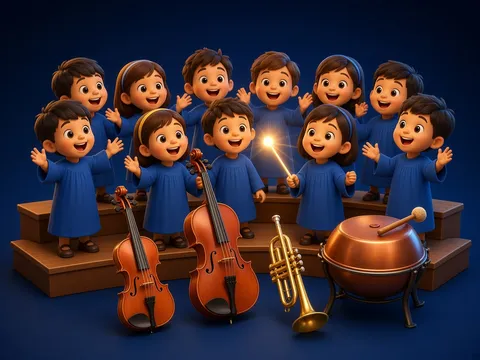
A cantata (from the Italian for “to sing”) is a vocal and instrumental work in several parts for choir, soloists and orchestra. The parts differ: in some the choir sings powerfully and grandly, in others a soloist sings a lyrical aria, and in others only the orchestra plays. One theme links all the parts: homeland, nature, a celebration, heroism. Unlike an opera, a cantata isn’t acted on stage with scenery and costumes; it is performed as a concert. The German composer Johann Sebastian Bach wrote more than 200 cantatas. When listening, we follow the performers (choir, soloist, orchestra) and the mood of each part.
 What the book shows

In grade 5 music lessons link music with poetry, painting and the stage. Each topic has a listening example, questions and a performing task.
Textbook link:
This is not the textbook’s text but a short description of the topic. Check the exact page in your own textbook.
 The lesson step by step
- 1
Warm-up5 min
A choir on a big stage.
- 2
New topic10 min
What is a cantata?
- 3
Practice10 min
The performers.
- 4
Game10 min
Moods of the parts.
- 5
Wrap-up5 min
Cantata and opera.
 Let’s understand
For the student Simple language
| Part | Who performs? | Mood |
|---|---|---|
| I | choir + orchestra | grand |
| II | soloist | lyrical |
| III | orchestra | descriptive |
| IV | everyone | bright finale |
 For the parent
How to help
- Listen to two parts of a cantata and ask: who is singing, and how did the mood change?
 For the teacher
 Lesson goals
- Know that a cantata is a multi-part work for choir, soloists and orchestra, and pick out its parts and performers by ear.
How to teach it
- Listening and analysis, singing, comparison tables, short presentations
 Differentiation
- Weaker pupils: simple rhythm and movement; stronger pupils make their own rhythm
 Questions for the class
- Which performers does a cantata bring together?
 How to check
The pupil identifies a cantata’s performers and parts by ear.
 Scientific Scientific language
Cantata vs opera
Both have choir, soloists and orchestra, but an opera acts out a story on stage.
Oratorio
A bigger vocal-instrumental work, usually with a story, is an oratorio.
Self-study
Step by step
- I defined a cantata.
- I picked out choir, soloist and orchestra.
- I compared the moods of parts.
- I told a cantata from an opera.
Going deeper
 Scientific language: for older students, parents and teachers.
Special cantatas are often performed at big celebrations, because choir and orchestra together sound grand.
 Play and check
Part of a cantata or not?
 How to write it down
- Draw a diagram of a cantata’s performers.
- Write the mood of the part you heard.
How the classwork looks in the notebook
Sample: the date and heading follow this country’s notebook rules.
 Watch out: common mistakes
 Where it helps in life
- Mugham dastgahs
 At home
Core
- If you wrote a cantata about the homeland, how would you plan 3 parts? Give the performers and mood of each.
Extra ⭐
- Write 2 similarities and 2 differences between a cantata and an opera.
How to do it
- Listen or sing with a grown-up.
- Say in words what you felt.
Answers for parents
Example: I, choir and orchestra, grand; II, a soloist, lyrical; III, everyone, a bright finale. Similar: choir, soloists, orchestra; several parts. Different: an opera acts out a story with scenery and costumes.
Step-by-step homework solution — Show the solution (try it yourself first)
Think
- In a cantata the choir carries shared feelings (joy, pride) and the soloist one person’s own feelings; switching between them keeps the work alive.
How the homework looks in the notebook
Sample: the date and heading follow this country’s notebook rules.

 About cookies