


Mugham dastgahs


 About this lesson
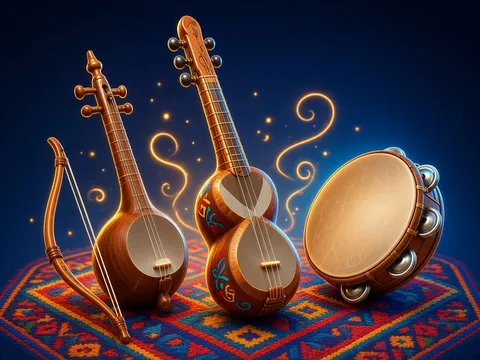
Mugham is the classical music art of the Azerbaijani people, alive for centuries. In mugham the melody is developed by improvisation, created during the performance. In 2003 UNESCO proclaimed Azerbaijani mugham a masterpiece of the oral and intangible heritage of humanity. A mugham dastgah is a large work in many parts: it begins with the bardasht (introduction), then come shobe and gushe sections, with rhythmic instrumental pieces (rang) and rhythmic songs (tasnif) in between. The main mughams are Rast, Shur, Segah, Chahargah, Bayati-Shiraz, Shushtar and Humayun. A trio usually performs it: the khanende (singer, who also plays the gaval), a tar player and a kamancha player.
 What the book shows

In grade 5 music lessons link music with poetry, painting and the stage. Each topic has a listening example, questions and a performing task.
Textbook link:
This is not the textbook’s text but a short description of the topic. Check the exact page in your own textbook.
 The lesson step by step
- 1
Warm-up5 min
Mugham plays.
- 2
New topic10 min
What is mugham?
- 3
Practice10 min
How a dastgah is built.
- 4
Game10 min
The mugham trio.
- 5
Wrap-up5 min
The main mughams.
 Let’s understand
For the student Simple language
| Part | What is it? |
|---|---|
| bardasht | introduction |
| shobe, gushe | main improvised sections |
| rang | rhythmic instrumental piece |
| tasnif | rhythmic song |
 For the parent
How to help
- Listen to a mugham performance together and try to name the instruments: tar, kamancha, gaval.
 For the teacher
 Lesson goals
- Know that mugham is Azerbaijan’s classical music art, recognise the parts of a dastgah and the mugham trio, and name the main mughams.
How to teach it
- Listening and analysis, singing, comparison tables, short presentations
 Differentiation
- Weaker pupils: simple rhythm and movement; stronger pupils make their own rhythm
 Questions for the class
- Why is mugham re-created each time it is performed?
 How to check
The pupil lists the parts of a dastgah, the trio’s instruments and the main mughams.
 Scientific Scientific language
Improvisation
No two singers, or even one singer twice, perform a mugham the same way: it is re-created each time.
Mode
Each mugham has its own mode and mood: Rast bright, Shur lyrical, Segah gentle and tender.
Self-study
Step by step
- I explained what mugham is.
- I named the parts of a dastgah.
- I recognised the trio’s instruments.
- I named 3 mughams.
Going deeper
 Scientific language: for older students, parents and teachers.
In Uzeyir Hajibeyli’s opera “Leyli and Majnun”, mugham singing was built into an opera, joining Eastern and Western music.
 Play and check
What is it?
 How to write it down
- Draw a dastgah diagram: bardasht → sections → rangs and tasnifs → ending.
- Write the 7 main mughams.
How the classwork looks in the notebook
Sample: the date and heading follow this country’s notebook rules.
 Watch out: common mistakes
 Where it helps in life
- Musical portraits
 At home
Core
- Listen to a mugham and describe its mood in 3–4 sentences.
Extra ⭐
- Draw the trio’s instruments and label them.
How to do it
- Listen or sing with a grown-up.
- Say in words what you felt.
Answers for parents
Answers depend on the recording. Instruments: tar (strings, played with a plectrum), kamancha (strings, played with a bow), gaval (frame drum, played by the singer).
Step-by-step homework solution — Show the solution (try it yourself first)
Think
- Mugham isn’t fully written down: it passes from master to pupil by listening and repeating, which is why it is called oral heritage.
How the homework looks in the notebook
Sample: the date and heading follow this country’s notebook rules.

 About cookies