


Angles and measuring them


 About this lesson
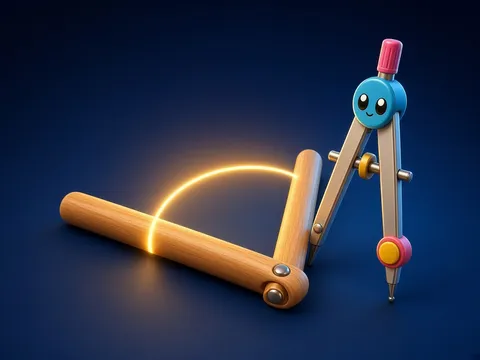
Two rays starting from one point make an angle. The point is the vertex and the rays are the arms. An angle is named with three letters with the vertex in the middle, ∠ABC, or with one letter, ∠B. Angles are measured in degrees (°). A right angle is 90°, like the corner of a page. An angle smaller than 90° is acute; one bigger than 90° but smaller than 180° is obtuse. An angle whose arms form a straight line is a straight angle of 180°. To measure an angle with a protractor, put the protractor’s centre on the vertex, line the zero line up with one arm and read the mark where the other arm crosses. A protractor has two scales; read the one that starts from zero on your arm. To draw an angle, draw a ray, place the protractor, mark a dot at the right degree and join it to the vertex. Before measuring, judge by eye whether the angle is acute or obtuse — an acute angle cannot be 120°.
 What the book shows

In the grade 5 maths textbook a topic usually comes with a real-life example, a rule, a worked example and tasks of different difficulty. Read the example carefully, say the rule in your own words, then solve the tasks in your notebook and check the answer.
Textbook link:
This is not the textbook’s text but a short description of the topic. Check the exact page in your own textbook.
 The lesson step by step
- 1
Warm-up5 min
A protractor and rays.
- 2
New topic10 min
Parts of an angle.
- 3
Practice10 min
Types of angles.
- 4
Game10 min
Measuring.
- 5
Wrap-up5 min
Drawing angles.
 Let’s understand
For the student Simple language
| Angle | Size | Example |
|---|---|---|
| acute | < 90° | clock hands at 1 o’clock |
| right | = 90° | a page corner |
| obtuse | 90°–180° | an open laptop |
| straight | = 180° | a straight line |
 For the parent
How to help
- Hunt for 3 acute, 3 right and 3 obtuse angles at home together: a door, scissors, a book, a clock.
 For the teacher
 Lesson goals
- Name the parts of an angle, tell acute, right, obtuse and straight angles apart, and measure and draw angles with a protractor.
How to teach it
- Modelling, worked examples, pair problem-solving, estimating and checking, independent work
 Differentiation
- Weaker pupils work step by step from a model; stronger pupils solve multi-step problems and write their own
 Questions for the class
- How do we measure and draw an angle?
 How to check
The pupil names the parts of an angle, tells the types apart, and measures and draws angles with a protractor.
 Scientific Scientific language
The clock model
At 3 o’clock the hands make 90°; at 6 o’clock they make 180°.
Turns
A full turn is 360°, a half turn 180° and a quarter turn 90°.
Self-study
Step by step
- I showed the vertex and arms.
- I told the angle types apart.
- I measured with a protractor.
- I drew a given angle.
 Terms in this lesson
Tap an underlined word — its meaning opens in the glossary.
- Angle
- Two rays from one point; measured in degrees.
Going deeper
 Scientific language: for older students, parents and teachers.
Dividing a circle into 360 degrees comes from ancient Babylonian astronomers, who used a base-60 number system.
 Play and check
What type of angle is it?
 How to write it down
- Draw 40°, 90° and 135° with a protractor.
- Write the type of each.
- Draw a triangle, measure its angles and add them up.
How the classwork looks in the notebook
Sample: the date and heading follow this country’s notebook rules.
 Watch out: common mistakes
 Where it helps in life
- Symmetry, rotation and translation
 At home
Core
- Write the type of angle between the clock hands at 2, 3, 5 and 6 o’clock.
Extra ⭐
- Find the angles in the first letter of your name and write their types.
How to do it
- Solve the tasks in your notebook.
- Check each answer by estimating or with the inverse operation.
Answers for parents
40° is acute, 90° is right, 135° is obtuse. A triangle’s angles should add up to about 180°. Homework: 2 o’clock — acute (60°), 3 — right (90°), 5 — obtuse (150°), 6 — straight (180°).
Step-by-step homework solution — Show the solution (try it yourself first)
Let’s solve
- A ray splits a straight angle into two parts; one is 65°. How big is the other? A straight angle is 180°, so 180° − 65° = 115°. 115° is obtuse and 65° is acute.
How the homework looks in the notebook
Sample: the date and heading follow this country’s notebook rules.

 About cookies