


What a percent is


 About this lesson
 What the book shows

The textbook usually opens the topic with a 100-cell square and everyday examples — discounts, survey results — and then links percents to fractions and decimals.
Textbook link:
This is not the textbook’s text but a short description of the topic. Check the exact page in your own textbook.
 The lesson step by step
- 1
A discount label5 min
What does “20%” mean?
- 2
A hundred cells10 min
We shade percents on a grid.
- 3
Three forms10 min
Percent, fraction, decimal table.
On the board25% = 1/4 = 0,25 - 4
Problems15 min
Class, survey and shop examples.
- 5
Wrap-up5 min
The less/more than half game.
 Let’s understand
For the student Simple language
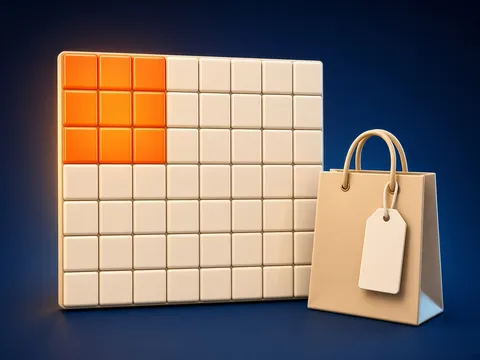
Imagine a square of 100 cells. Shade 25 — you have shaded 25%, a quarter.
 For the parent
How to help
- Read discount labels together in shops.
- Ask about the phone battery: more than half?
- Cut a pizza and ask: what percent did we eat?
What to check
- Knows that 50% is half.
- Writes 25% as 1/4 and 0.25.
 For the teacher
 Lesson goals
- Understand percent as a hundredth and switch between forms.
How to teach it
- 10 × 10 grids, a table, real labels.
 Differentiation
- For those who struggle: only 50%, 25%, 10%.
- For fast finishers: percents over 100.
 Questions for the class
- Why are percents handy for comparing?
 How to check
The pupil converts 4 of 5 correctly.
 Scientific Scientific language
The core idea
A percent is another way of writing a fraction over 100: 37% = 37/100 = 0.37. Percents let us compare wholes of different sizes.
Techniques
- Shading a 10 × 10 grid.
- A percent ↔ fraction ↔ decimal table.
- Real discount and advert examples.
Self-study
Step-by-step plan
- Put the percent over 100: 40% = 40/100.
- Simplify: 40/100 = 2/5.
- As a decimal: 0.40.
 Terms in this lesson
Tap an underlined word — its meaning opens in the glossary.
- Percent
- One hundredth: 1% = 1/100.
- Mean
- The sum of the numbers divided by how many there are.
- Fraction
- Equal parts of a whole: a/b.
- Decimal
- A fraction over 10, 100, 1000: 0.7.
- Denominator
- The bottom number — how many parts in the whole.
Going deeper
 Scientific language: for older students, parents and teachers.
Percents put wholes on the same scale: 5 of a class of 20 or 8 of a class of 40 — which is more? In percents: 25% and 20%. That is why percents are the everyday language of statistics and economics.
Careful: “up 50%, then down 50%” does not return to the old price — the second percent is taken of a different whole.
 Play and check
Is it more or less than half?
 How to write it down
- Draw a table: percent | fraction | decimal.
- Fill it for 50%, 25%, 10%, 75%.
- Shade 30% of a 10 × 10 grid.
How the classwork looks in the notebook
Sample: the date and heading follow this country’s notebook rules.
 Watch out: common mistakes
 Where it helps in life
- Discounts and prices.
- Battery and download bars.
- Charts and surveys.
- Later — bank interest.
 At home
Core
- Write as a fraction and a decimal: 20%, 5%, 60%.
- Write as a percent: 1/2, 3/4, 0.07.
Challenge ⭐
- A class has 25 pupils; 5 wear glasses. What percent is that?
How to do it
- Put the percent over 100 and simplify.
- To get a percent, make the denominator 100.
- Challenge: first write 5/25, then make the denominator 100.
Answers for parents
20% = 1/5 = 0.2; 5% = 1/20 = 0.05; 60% = 3/5 = 0.6. 1/2 = 50%, 3/4 = 75%, 0.07 = 7%. ⭐ 5/25 = 20/100 = 20%.
Step-by-step homework solution — Show the solution (try it yourself first)
20%, 5%, 60%
- Put each over 100 and simplify: 20/100 = 1/5 = 0.2; 5/100 = 1/20 = 0.05; 60/100 = 3/5 = 0.6.
1/2, 3/4, 0,07
- Make the denominator 100: 50/100, 75/100, 7/100.
⭐ 5/25
- Multiply top and bottom by 4: 20/100 = 20%.
How the homework looks in the notebook
Sample: the date and heading follow this country’s notebook rules.

 About cookies