


Levels of organisation in the body

 About this lesson
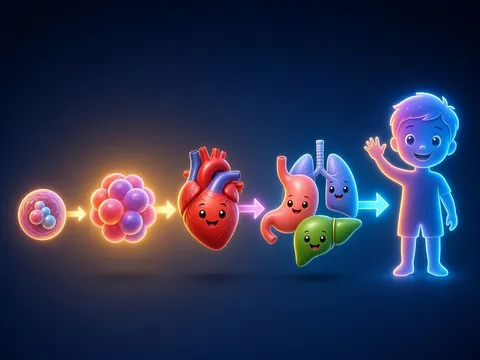
All living things are made of cells. A cell is the smallest unit of structure and life, and usually it can only be seen with a microscope. Some living things, such as bacteria, are a single cell, while the human body is made of billions of cells. Cells that are similar in structure and job group together to form a tissue: muscle tissue contracts, nerve tissue carries signals, bone tissue supports the body. Several tissues together form an organ that does a particular job: the heart, stomach, lungs or brain. Organs that work together on a shared job form an organ system: the digestive system (mouth, oesophagus, stomach, intestines), the respiratory system, the circulatory system, the nervous system and the musculoskeletal system. All the systems working together make one organism, a living body. The levels are cell → tissue → organ → organ system → organism. If one system stops working properly, the whole organism is affected, so we must look after every part of the body.
 What the book shows

In grade 5 Natural Science covers the human body and health, the diversity of living things, substances and their properties, energy, force and motion, and the environment. Read the topic in the textbook, do simple experiments with an adult watching, and record what you observe in your notebook.
Textbook link:
This is not the textbook’s text but a short description of the topic. Check the exact page in your own textbook.
 The lesson step by step
- 1
Warm-up5 min
From brick to building: how is the body built?
- 2
New topic10 min
The cell and the microscope.
- 3
Practice10 min
Tissues and organs.
- 4
Game10 min
Organ systems.
- 5
Wrap-up5 min
The levels staircase.
 Let’s understand
For the student Simple language
| Level | Example |
|---|---|
| cell | a muscle cell |
| tissue | muscle tissue |
| organ | the heart |
| organ system | the circulatory system |
| organism | a human |
 For the parent
How to help
- Play a nesting-doll game: cell → tissue → organ → system → organism; find a house comparison for each level (brick → wall → room → floor → building).
 For the teacher
 Lesson goals
- Know the terms cell, tissue, organ, organ system and organism, put them in order from smallest to largest, and give an example of each.
How to teach it
- Observation, simple experiments, building models, tables and diagrams, mini-research
 Differentiation
- Weaker pupils work from pictures and diagrams; stronger pupils plan their own experiment and draw conclusions
 Questions for the class
- How is our body built from small parts?
 How to check
The pupil names the levels in order, gives an example of each and explains how systems work together.
 Scientific Scientific language
The microscope
In the 17th century the English scientist Robert Hooke saw cells through a microscope and gave them their name.
The largest organ
Skin is counted as the largest organ of the human body.
Self-study
Step by step
- I named the levels.
- I put them in the right order.
- I gave an example of each.
- I explained how systems work together.
Going deeper
 Scientific language: for older students, parents and teachers.
Some animals, such as sea sponges, have no well-developed tissues or organs — a sign of how varied living things are.
 Play and check
Which level is it?
 How to write it down
- Draw a staircase diagram of the levels with an example on each step.
- Write 3 organ systems and their organs.
How the classwork looks in the notebook
Sample: the date and heading follow this country’s notebook rules.
 Watch out: common mistakes
 Where it helps in life
- Skeleton and muscles
 At home
Core
- Choose one organ and write 5 sentences on which system it belongs to and what it does.
Extra ⭐
- Draw a diagram explaining the levels with a building comparison.
How to do it
- Read the topic in the textbook.
- Copy the key words and diagram into your notebook, then make one simple observation and record it.
Answers for parents
Example: the lungs belong to the respiratory system; they pass oxygen into the blood and remove carbon dioxide.
Step-by-step homework solution — Show the solution (try it yourself first)
Think
- When we run, why does the heart beat fast and we breathe quickly? The muscles need more oxygen: the respiratory system takes in more, and the circulatory system carries it to the muscles faster. The systems work together like a team.
How the homework looks in the notebook
Sample: the date and heading follow this country’s notebook rules.

 About cookies