


Skeleton and muscles


 About this lesson
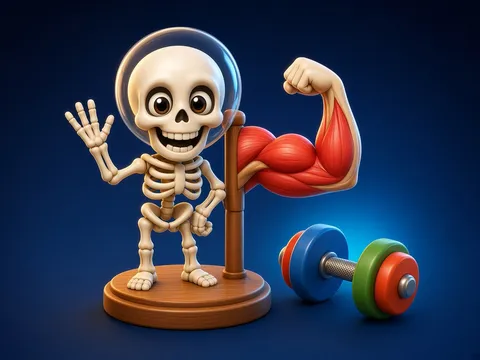
The skeleton and muscles together make up the musculoskeletal system. The skeleton has three main jobs: it supports the body and gives it shape, protects the internal organs, and helps us move. An adult skeleton has about 206 bones. Its main parts are the skull (protecting the brain), the spine (the body’s main support, protecting the spinal cord), the ribcage (protecting the heart and lungs), and the bones of the arms and legs. The longest bone is the thigh bone (femur). Places where bones meet and move are joints: the knee, elbow and shoulder. Muscles are attached to bones by tendons and move them by contracting (getting shorter). A muscle can only pull, not push, so muscles work in pairs: when you bend your arm the front muscle contracts and the back one relaxes, and when you straighten it the opposite happens. The heart is a muscle too and works non-stop for a whole lifetime. To keep bones and muscles healthy we need good food (calcium and protein), regular exercise, good sitting posture, and not carrying a heavy bag on one shoulder.
 What the book shows

In grade 5 Natural Science covers the human body and health, the diversity of living things, substances and their properties, energy, force and motion, and the environment. Read the topic in the textbook, do simple experiments with an adult watching, and record what you observe in your notebook.
Textbook link:
This is not the textbook’s text but a short description of the topic. Check the exact page in your own textbook.
 The lesson step by step
- 1
Warm-up5 min
What if we had no bones?
- 2
New topic10 min
Parts and jobs of the skeleton.
- 3
Practice10 min
Joints.
- 4
Game10 min
Muscles work in pairs.
- 5
Wrap-up5 min
Rules for good posture.
 Let’s understand
For the student Simple language
| Part | What it protects or does |
|---|---|
| skull | the brain |
| spine | support, the spinal cord |
| ribcage | heart and lungs |
| joint | lets bones move |
 For the parent
How to help
- Check your child’s sitting posture and school-bag weight together, and get into the habit of a short movement break every 30–40 minutes of study.
 For the teacher
 Lesson goals
- Know what the skeleton and muscles do, name the main parts of the skeleton, explain the role of joints and how muscles work in pairs, and follow the rules of good posture.
How to teach it
- Observation, simple experiments, building models, tables and diagrams, mini-research
 Differentiation
- Weaker pupils work from pictures and diagrams; stronger pupils plan their own experiment and draw conclusions
 Questions for the class
- How do the skeleton and muscles help us move?
 How to check
The pupil explains the skeleton’s jobs and main parts, joints, muscles working in pairs and rules for good posture.
 Scientific Scientific language
The smallest bone
The stirrup bone inside the ear is the smallest in the body.
Babies have more
A newborn has more bones, and some fuse together as the child grows.
Self-study
Step by step
- I gave the skeleton’s jobs.
- I named its main parts.
- I explained joints.
- I showed muscles working in pairs.
Going deeper
 Scientific language: for older students, parents and teachers.
In weightlessness astronauts’ bones and muscles weaken, so they do special exercises every day in space.
 Play and check
Which job of the skeleton is it?
 How to write it down
- Draw a simple skeleton and label 5 parts.
- Explain with a drawing and 2 sentences how the muscles work when you bend your arm.
How the classwork looks in the notebook
Sample: the date and heading follow this country’s notebook rules.
 Watch out: common mistakes
 Where it helps in life
- Digestion, breathing and circulation
 At home
Core
- Move 3 joints at home (knee, elbow, finger) and write how each one moves.
Extra ⭐
- Write 5 rules for healthy bones and muscles.
How to do it
- Read the topic in the textbook.
- Copy the key words and diagram into your notebook, then make one simple observation and record it.
Answers for parents
Rules: sit up straight; move every day; eat dairy and protein foods; carry your bag on both shoulders; get enough sleep.
Step-by-step homework solution — Show the solution (try it yourself first)
Think
- Why is a heavy bag on one shoulder harmful? The weight falls on one side, the spine bends and the muscles on one side get very tired. Over time posture can suffer. Carrying it on both shoulders shares the load evenly.
How the homework looks in the notebook
Sample: the date and heading follow this country’s notebook rules.

 About cookies