


Flowering and non-flowering plants


 About this lesson
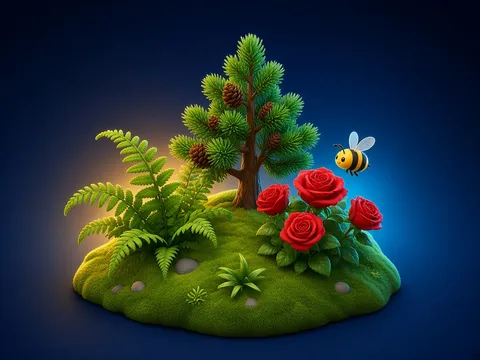
Plants fall into two big groups by how they reproduce. Non-flowering plants make no flowers or fruit. Mosses are small, low plants that grow like a carpet in damp, shady places; they have no roots and reproduce by spores. Ferns have roots, a stem and large feather-like leaves, with clusters of spores underneath. Conifers (pine, fir, cypress) reproduce by seeds, but the seeds ripen between the scales of cones rather than inside a fruit; their leaves are needles and most stay green in winter. Flowering plants are the largest plant group: trees, shrubs, grasses, vegetables and cereals. Their organ of reproduction is the flower. When pollen reaches another flower of the same kind, pollination happens, helped by bees, butterflies or the wind. After pollination the flower forms a fruit with seeds inside. A seed is the start of a new plant.
 What the book shows

In grade 5 Natural Science covers the human body and health, the diversity of living things, substances and their properties, energy, force and motion, and the environment. Read the topic in the textbook, do simple experiments with an adult watching, and record what you observe in your notebook.
Textbook link:
This is not the textbook’s text but a short description of the topic. Check the exact page in your own textbook.
 The lesson step by step
- 1
Warm-up5 min
Moss, fern, pine and rose: what do they share?
- 2
New topic10 min
Non-flowering plants.
- 3
Practice10 min
Flowering plants.
- 4
Game10 min
Pollination and seeds.
- 5
Wrap-up5 min
A plant collection.
 Let’s understand
For the student Simple language
| Group | How it reproduces | Example |
|---|---|---|
| mosses | by spores | green moss |
| ferns | by spores | fern |
| conifers | seeds in cones | pine |
| flowering plants | seeds in fruit | rose |
 For the parent
How to help
- On a walk, find moss, a fern (in a park), a pine cone and a flower together; photograph each and name its group.
 For the teacher
 Lesson goals
- Sort plants into flowering and non-flowering groups, know the features of mosses, ferns and conifers, and explain what flowers do and what pollination is.
How to teach it
- Observation, simple experiments, building models, tables and diagrams, mini-research
 Differentiation
- Weaker pupils work from pictures and diagrams; stronger pupils plan their own experiment and draw conclusions
 Questions for the class
- How do plants reproduce, and how does that group them?
 How to check
The pupil sorts plants into flowering and non-flowering, describes mosses, ferns and conifers, and explains pollination.
 Scientific Scientific language
What is a spore?
A reproductive cell smaller than a speck of dust that grows into a new plant in a suitable damp place.
Ancient ferns
Millions of years ago there were giant fern forests, and some coal formed from their remains.
Self-study
Step by step
- I sorted plants into two groups.
- I described mosses and ferns.
- I explained conifer seeds.
- I explained pollination.
Going deeper
 Scientific language: for older students, parents and teachers.
The Eldar pine is one of Azerbaijan’s rare trees; its natural forest is protected at Eldar Oyugu.
 Play and check
Which group does it belong to?
 How to write it down
- Draw a simple flower and an arrow diagram of pollination.
- Write the 3 non-flowering groups with examples.
How the classwork looks in the notebook
Sample: the date and heading follow this country’s notebook rules.
 Watch out: common mistakes
 Where it helps in life
- States of matter and the particle model
 At home
Core
- Observe a pine cone or fern leaf, draw it and write 4 sentences.
Extra ⭐
- Explain in 5 sentences why bees matter to plants.
How to do it
- Read the topic in the textbook.
- Copy the key words and diagram into your notebook, then make one simple observation and record it.
Answers for parents
Example: as bees collect nectar they carry pollen from flower to flower, which helps pollination. Without pollination many flowering plants could not make seeds and fruit.
Step-by-step homework solution — Show the solution (try it yourself first)
Think
- Why do we find moss in damp forests and not in dry deserts? Moss has no roots and soaks up water through its whole body, and its spores need damp to grow. A plant’s structure decides where it can live.
How the homework looks in the notebook
Sample: the date and heading follow this country’s notebook rules.

 About cookies