


Vertebrates and invertebrates


 About this lesson
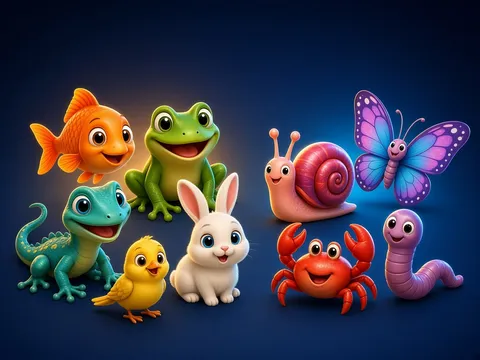
Scientists sort animals into groups to make them easier to study. The most basic division is whether an animal has a backbone. Vertebrates have a spine and an internal skeleton, and they fall into five classes. Fish live in water, breathe with gills, are covered in scales and have fins. Amphibians, such as frogs, spend part of their lives in water and part on land, have moist bare skin and lay spawn. Reptiles, such as lizards, snakes and tortoises, are covered in horny scales and lay eggs on land. Birds have feathers, wings and beaks and lay hard-shelled eggs. Mammals, such as rabbits, dogs and humans, are covered in hair or fur and feed their young on milk. Invertebrates have no backbone, and the great majority of animal species on Earth are invertebrates. They include insects (butterflies, bees, ants, with 6 legs), spiders (8 legs), crustaceans (crayfish, shrimps), molluscs (snails, mussels) and worms (earthworms). Some invertebrates have a hard outer covering (insects, crabs) or a shell (snails).
 What the book shows

In grade 5 Natural Science covers the human body and health, the diversity of living things, substances and their properties, energy, force and motion, and the environment. Read the topic in the textbook, do simple experiments with an adult watching, and record what you observe in your notebook.
Textbook link:
This is not the textbook’s text but a short description of the topic. Check the exact page in your own textbook.
 The lesson step by step
- 1
Warm-up5 min
An animal parade: how shall we group them?
- 2
New topic10 min
What a backbone is.
- 3
Practice10 min
The five vertebrate classes.
- 4
Game10 min
The world of invertebrates.
- 5
Wrap-up5 min
Animal passports.
 Let’s understand
For the student Simple language
| Class | Covering | Example |
|---|---|---|
| fish | scales | salmon |
| amphibians | moist skin | frog |
| reptiles | horny scales | lizard |
| birds | feathers | sparrow |
| mammals | hair or fur | rabbit |
 For the parent
How to help
- Spend 10 minutes in a yard or park noting every animal you see, then sort them into vertebrates and invertebrates together.
 For the teacher
 Lesson goals
- Sort animals into two groups by whether they have a backbone, know the five classes of vertebrates and their features, and give examples of the main invertebrate groups.
How to teach it
- Observation, simple experiments, building models, tables and diagrams, mini-research
 Differentiation
- Weaker pupils work from pictures and diagrams; stronger pupils plan their own experiment and draw conclusions
 Questions for the class
- What do we use to sort animals into groups?
 How to check
The pupil sorts animals into vertebrates and invertebrates, names the 5 vertebrate classes with their features and gives invertebrate examples.
 Scientific Scientific language
A whale is not a fish!
Whales and dolphins live in water but are mammals: they breathe with lungs and feed their young on milk.
A spider is not an insect
Insects have 6 legs, spiders 8.
Self-study
Step by step
- I sorted animals into two groups.
- I named the 5 vertebrate classes.
- I gave a feature of each.
- I gave invertebrate examples.
Going deeper
 Scientific language: for older students, parents and teachers.
Azerbaijan’s Red Book lists rare and protected animals, including both vertebrates and invertebrates.
 Play and check
Vertebrate or invertebrate?
 How to write it down
- Draw a table of the 5 vertebrate classes with a feature and 2 examples each.
- List 5 invertebrates and their groups.
How the classwork looks in the notebook
Sample: the date and heading follow this country’s notebook rules.
 Watch out: common mistakes
 Where it helps in life
- Flowering and non-flowering plants
 At home
Core
- Make a “passport” for your favourite animal: group, class, covering, food and habitat.
Extra ⭐
- Find and draw 3 invertebrates at home or outside.
How to do it
- Read the topic in the textbook.
- Copy the key words and diagram into your notebook, then make one simple observation and record it.
Answers for parents
Example: sparrow — vertebrate, bird class, covered in feathers, eats seeds and insects, lives in towns and villages.
Step-by-step homework solution — Show the solution (try it yourself first)
Think
- A tortoise and a snail both have a hard “house”, so why is one a vertebrate and the other not? Because the group is decided by the inside, not the outside: the tortoise has a spine and skeleton, the snail does not. In science we look for the key feature.
How the homework looks in the notebook
Sample: the date and heading follow this country’s notebook rules.

 About cookies