


Natural disasters


 About this lesson
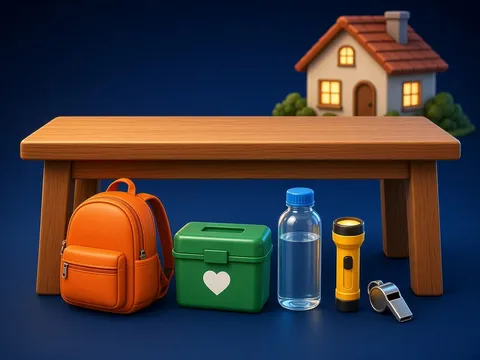
Natural disasters are dangerous natural events that can harm people, homes and farms. An earthquake is shaking of the ground caused by rocks shifting deep in the Earth’s crust. In a volcanic eruption molten rock (lava), ash and gases come up from deep inside the Earth. A flood is when rivers overflow after heavy rain or fast-melting snow. A mudflow is a fast rush of water, mud and stones down a mountain after a downpour. A landslide is soil and rock sliding down a slope, often after heavy rain. A drought is a long time without rain when plants dry up, and a hurricane is an extremely strong wind. In Azerbaijan earthquakes, mudflows on mountain rivers of the Greater and Lesser Caucasus, river floods and landslides on slopes are the most common. Absheron and Gobustan have mud volcanoes, which erupt mud rather than lava. In an earthquake stay calm, get under a sturdy table, protect your head with your arms, keep away from windows and glass and do not use the lift; outdoors, move away from buildings, trees and power poles. In a flood or mudflow go to high ground and never walk into flowing water. Every family should keep an emergency bag ready (water, a torch, a first-aid kit, copies of documents, a whistle). In Azerbaijan the emergency number is 112.
 What the book shows

In grade 5 Natural Science covers the human body and health, the diversity of living things, substances and their properties, energy, force and motion, and the environment. Read the topic in the textbook, do simple experiments with an adult watching, and record what you observe in your notebook.
Textbook link:
This is not the textbook’s text but a short description of the topic. Check the exact page in your own textbook.
 The lesson step by step
- 1
Warm-up5 min
The emergency bag: what goes in it?
- 2
New topic10 min
Disasters and their causes.
- 3
Practice10 min
Disasters in Azerbaijan.
- 4
Game10 min
Safety rules.
- 5
Wrap-up5 min
A family plan.
 Let’s understand
For the student Simple language
| Disaster | What to do |
|---|---|
| earthquake | get under a table, protect your head |
| flood, mudflow | go to high ground |
| storm | stay indoors, away from windows |
| always | call 112 |
 For the parent
How to help
- Make a family emergency plan: where is the safest place at home, where will everyone meet, who will you call? Pack the emergency bag together.
 For the teacher
 Lesson goals
- Know the main natural disasters (earthquakes, mudflows, floods, landslides, droughts, storms, volcanoes) and their causes, name those most common in Azerbaijan, and follow safety rules during a disaster.
How to teach it
- Observation, simple experiments, building models, tables and diagrams, mini-research
 Differentiation
- Weaker pupils work from pictures and diagrams; stronger pupils plan their own experiment and draw conclusions
 Questions for the class
- How can we keep safe in a natural disaster?
 How to check
The pupil explains the main disasters and their causes, names those common in Azerbaijan and lists the safety rules.
 Scientific Scientific language
The seismograph
An instrument that records earthquakes; seismic stations in Azerbaijan watch for tremors all the time.
Why a whistle?
A whistle carries further than a shout and takes less effort for someone trapped.
Self-study
Step by step
- I named the main disasters.
- I explained their causes.
- I named those common in Azerbaijan.
- I listed the safety rules.
Going deeper
 Scientific language: for older students, parents and teachers.
In earthquake zones such as Japan buildings are designed to withstand shaking, and schools hold regular drills.
 Play and check
In an earthquake, is it right or wrong?
 How to write it down
- Make a table of disasters: name, cause, safety rule.
- Write a list for an emergency bag.
How the classwork looks in the notebook
Sample: the date and heading follow this country’s notebook rules.
 Watch out: common mistakes
 Where it helps in life
- Grade 6: energy, heat and ecosystems
 At home
Core
- Make an emergency plan with your family and write it in your notebook.
Extra ⭐
- Draw a small poster: “What to do in an earthquake”.
How to do it
- Read the topic in the textbook.
- Copy the key words and diagram into your notebook, then make one simple observation and record it.
Answers for parents
Bag: drinking water, a torch and batteries, a first-aid kit, a whistle, copies of documents, warm clothes, a power bank, family contact numbers.
Step-by-step homework solution — Show the solution (try it yourself first)
Think
- Why does cutting forests on slopes raise the risk of mudflows and landslides? Tree roots hold the soil and leaves soften the rain. Without trees rainwater easily washes the soil away. Protecting nature also helps prevent disasters.
How the homework looks in the notebook
Sample: the date and heading follow this country’s notebook rules.

 About cookies