


Renewable energy sources


 About this lesson
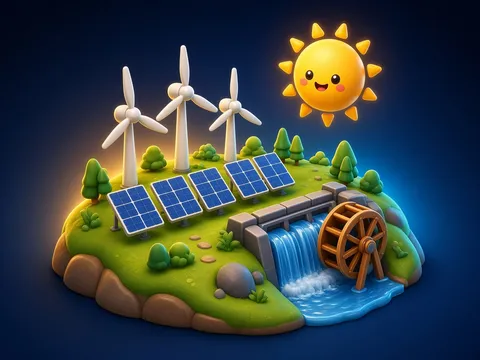
Electricity can be made from many sources. Non-renewable sources — oil, natural gas and coal — formed deep in the Earth over millions of years; using them uses them up, and burning them gives off gases that pollute the air. Renewable sources are constantly replaced by nature and do not run out. Solar energy: solar panels turn light straight into electricity, and solar collectors heat water. Wind energy: the wind turns the blades of a turbine and a generator makes electricity. Water (hydro) energy: water held back by a dam on a river flows down and spins turbines in a hydroelectric power station. Geothermal energy uses hot water and steam from deep underground. Bioenergy makes fuel and gas from plant waste and manure. Renewables do not run out and pollute the air much less, but they depend on the weather: there is no sun at night and no wind on calm days. In Azerbaijan hydroelectric stations such as the one at Mingachevir work on the Kur river, and in recent years solar and wind power stations have been built too. The country has many sunny days and windy places, which suits renewable energy.
 What the book shows

In grade 5 Natural Science covers the human body and health, the diversity of living things, substances and their properties, energy, force and motion, and the environment. Read the topic in the textbook, do simple experiments with an adult watching, and record what you observe in your notebook.
Textbook link:
This is not the textbook’s text but a short description of the topic. Check the exact page in your own textbook.
 The lesson step by step
- 1
Warm-up5 min
Why does a pinwheel spin?
- 2
New topic10 min
Renewable and non-renewable.
- 3
Practice10 min
Sun, wind and water.
- 4
Game10 min
Pros and cons.
- 5
Wrap-up5 min
The energy of the future.
 Let’s understand
For the student Simple language
| Source | What it drives | Renewable? |
|---|---|---|
| sun | panel: light → electricity | yes |
| wind | turbine blades | yes |
| water | hydro turbine | yes |
| oil, gas, coal | burning → heat | no |
 For the parent
How to help
- Make a paper pinwheel together and test it in different winds: what changes when the wind gets stronger?
 For the teacher
 Lesson goals
- Tell renewable from non-renewable energy sources, explain simply how solar, wind, hydro, geothermal and bioenergy work, and compare their advantages and drawbacks.
How to teach it
- Observation, simple experiments, building models, tables and diagrams, mini-research
 Differentiation
- Weaker pupils work from pictures and diagrams; stronger pupils plan their own experiment and draw conclusions
 Questions for the class
- Where should we get energy in the future, and why?
 How to check
The pupil sorts energy sources into renewable and non-renewable, explains how solar, wind and hydro work, and compares their pros and cons.
 Scientific Scientific language
The water wheel
Old mills used a water wheel, turned by flowing water, to drive the millstones.
Where do panels go?
Solar panels make most energy facing the sun with no shade.
Self-study
Step by step
- I told renewable from non-renewable.
- I explained solar, wind and hydro.
- I compared pros and cons.
- I gave an example from Azerbaijan.
Going deeper
 Scientific language: for older students, parents and teachers.
On the Absheron peninsula natural gas seeping from the ground burns by itself in places; Yanardag is one of them.
 Play and check
Renewable or non-renewable?
 How to write it down
- Draw a simple wind turbine or hydro station and show the energy changes with arrows.
- Write 2 advantages and 2 drawbacks of renewables.
How the classwork looks in the notebook
Sample: the date and heading follow this country’s notebook rules.
 Watch out: common mistakes
 Where it helps in life
- Natural disasters
 At home
Core
- Make a paper pinwheel and watch it spin in 3 different places.
Extra ⭐
- Write 6 sentences on “The energy of the future”.
How to do it
- Read the topic in the textbook.
- Copy the key words and diagram into your notebook, then make one simple observation and record it.
Answers for parents
Advantages: never runs out, little air pollution. Drawbacks: depends on the weather (night, calm days), and stations need a lot of land and money.
Step-by-step homework solution — Show the solution (try it yourself first)
Think
- Solar panels do not work at night, so how can the lights stay on? Extra daytime energy is stored in batteries for the night, or solar is combined with wind and hydro. The best answer is several sources working together.
How the homework looks in the notebook
Sample: the date and heading follow this country’s notebook rules.

 About cookies