


Art glass and metalwork


 About this lesson
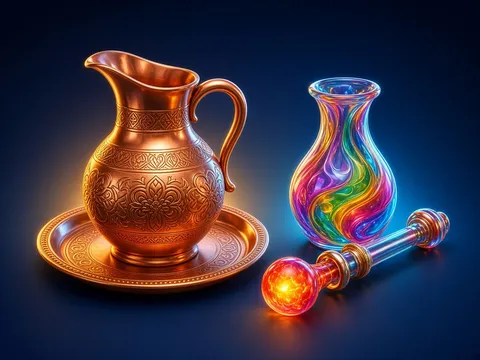
In decorative art an object is both useful and beautiful. Art glass: a craftsman blows hot, soft glass through a long pipe to shape a vessel, and coloured glass pieces are joined into stained glass, a coloured picture that lets light through. Azerbaijan has shebeke art too: wooden pieces are fitted together without nails or glue, with coloured glass between them; the windows of the Palace of the Shaki Khans are a famous example. Art metal: a craftsman makes vessels from copper, silver or bronze, hammers a pattern into the surface (chasing) or engraves it with a sharp tool. The village of Lahij in Ismayilli district is famous for copperwork handed down through generations. Patterns use plant motifs, the buta and geometric ornament.
 What the book shows

In grade 5 visual arts focuses on folk and decorative art: costume, coats of arms, glass, metal, tapestry and batik. Each topic has example works, a discussion of them and a creative task.
Textbook link:
This is not the textbook’s text but a short description of the topic. Check the exact page in your own textbook.
 The lesson step by step
- 1
Warm-up5 min
Beautiful, useful things.
- 2
New topic10 min
Art glass.
- 3
Practice10 min
Shebeke.
- 4
Game10 min
Metalwork and Lahij.
- 5
Wrap-up5 min
Sketching a vessel.
 Let’s understand
For the student Simple language
| Technique | Material | How? |
|---|---|---|
| glassblowing | glass | blowing hot glass through a pipe |
| stained glass, shebeke | glass, wood | joining coloured pieces |
| chasing | copper | hammering a pattern |
| engraving | copper, silver | cutting with a sharp tool |
 For the parent
How to help
- Look at copper or glass dishes at home together: is the pattern hammered, engraved or painted?
 For the teacher
 Lesson goals
- Know the techniques of art glass and metal (blowing, stained glass, chasing, engraving), know Lahij copperwork, and sketch a patterned vessel.
How to teach it
- Looking and discussing, sketching, hands-on work, a mini-exhibition
 Differentiation
- Weaker pupils colour a ready outline; stronger pupils create their own composition
 Questions for the class
- How does a craftsman turn plain material into art?
 How to check
The pupil tells glass and metal techniques apart and sketches a patterned vessel.
 Scientific Scientific language
Why copper?
It is soft, easy to hammer and conducts heat well, which suits pots and pans.
How is glass made?
Glass is made by melting sand at very high temperatures.
Self-study
Step by step
- I named glass techniques.
- I named metal techniques.
- I talked about Lahij copperwork.
- I sketched a vessel.
Going deeper
 Scientific language: for older students, parents and teachers.
One copper vessel can take days: the sheet is cut, hammered into shape, and finally patterned and polished.
 Play and check
Glass art or metalwork?
 How to write it down
- Sketch a copper pot or glass vase and add a surface pattern.
- Copy the techniques table.
How the classwork looks in the notebook
Sample: the date and heading follow this country’s notebook rules.
 Watch out: common mistakes
 Where it helps in life
- Tapestry and batik
 At home
Core
- Make a small “stained glass” from coloured paper or a clear plastic sleeve and hold it up to the window.
Extra ⭐
- Find and write 3 facts about Lahij copperwork.
How to do it
- Prepare a quiet spot and materials.
- Show your work to a grown-up and explain it.
Answers for parents
Example facts: Lahij is in Ismayilli district; craftsmen hammer and decorate copper vessels by hand; the craft passes down the generations.
Step-by-step homework solution — Show the solution (try it yourself first)
Think
- In shebeke the pieces join without nails, so when wood swells and shrinks with heat and damp the window doesn’t crack: beauty and clever engineering together.
How the homework looks in the notebook
Sample: the date and heading follow this country’s notebook rules.

 About cookies