


Tapestry and batik


 About this lesson
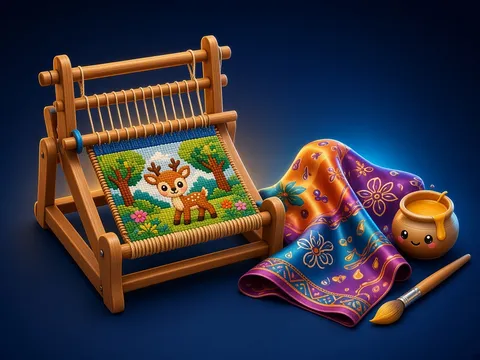
A tapestry is a picture woven by hand from thread on a loom and hung on a wall. Its name comes from the Gobelins workshop in Paris in the 17th century. Weft threads are passed between warp threads to build a coloured picture: landscapes, animals, historical scenes. Batik is painting on fabric. In hot batik the artist covers parts of the cloth with melted wax; dye can’t reach the waxed areas. The cloth is dyed, the wax removed, and the pattern appears. In cold batik special outline lines stop the dye from spreading. Batik has long been famous in Indonesia, on the island of Java. In both arts you first sketch, choose colours, then work part by part.
 What the book shows

In grade 5 visual arts focuses on folk and decorative art: costume, coats of arms, glass, metal, tapestry and batik. Each topic has example works, a discussion of them and a creative task.
Textbook link:
This is not the textbook’s text but a short description of the topic. Check the exact page in your own textbook.
 The lesson step by step
- 1
Warm-up5 min
Pictures from thread, painting on cloth.
- 2
New topic10 min
Tapestry.
- 3
Practice10 min
Batik.
- 4
Game10 min
Comparing.
- 5
Wrap-up5 min
Making a small piece.
 Let’s understand
For the student Simple language
| Tapestry | Batik | |
|---|---|---|
| what is it? | a woven picture | painting on cloth |
| material | thread, loom | cloth, dye, wax |
| main method | weft passes through warp | wax blocks the dye |
 For the parent
How to help
- Draw on paper with a white candle, then paint over it with watercolour: the waxed parts stay white, a simple model of batik.
 For the teacher
 Lesson goals
- Know that a tapestry is a woven picture and batik is painting on fabric, explain their techniques and make a simple design.
How to teach it
- Looking and discussing, sketching, hands-on work, a mini-exhibition
 Differentiation
- Weaker pupils colour a ready outline; stronger pupils create their own composition
 Questions for the class
- How does cloth become a work of art?
 How to check
The pupil explains tapestry and batik techniques and makes a simple piece.
 Scientific Scientific language
Why wax?
Wax repels water, so water-based dye can’t soak into waxed areas.
Warp and weft
Warp threads run lengthways on the loom; weft threads go across between them.
Self-study
Step by step
- I told tapestry from batik.
- I explained warp and weft.
- I said what the wax does.
- I made a simple design.
Going deeper
 Scientific language: for older students, parents and teachers.
Large tapestries could take years to weave, so palaces treasured them.
 Play and check
Tapestry or batik?
 How to write it down
- Weave a small piece with coloured thread on a cardboard frame, or make a “batik” with a candle and watercolour.
- Write the steps.
How the classwork looks in the notebook
Sample: the date and heading follow this country’s notebook rules.
 Watch out: common mistakes
 Where it helps in life
- Grade 6: architecture and sculpture
 At home
Core
- Sketch a batik pattern: a flower, leaf or bird motif.
Extra ⭐
- Write 2 similarities and 2 differences between tapestry and batik.
How to do it
- Prepare a quiet spot and materials.
- Show your work to a grown-up and explain it.
Answers for parents
Similar: both are decorative textile arts and both start with a sketch. Different: tapestry is woven and batik is dyed; tapestry uses thread, batik uses wax and dye.
Step-by-step homework solution — Show the solution (try it yourself first)
Think
- In batik light colours go on first and dark ones later, with wax covering each colour to keep; so the artist plans the order in advance.
How the homework looks in the notebook
Sample: the date and heading follow this country’s notebook rules.

 About cookies