


Working with thin sheet metal


 About this lesson
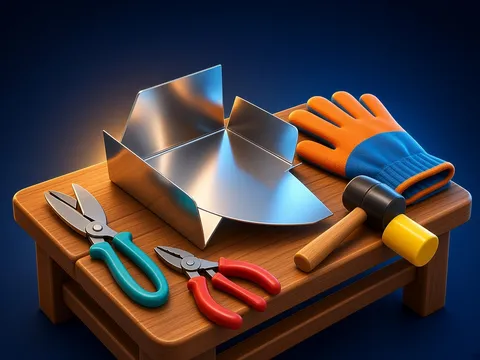
Thin sheet metal is a metal sheet of very small thickness. At school we usually work with aluminium foil and thin tinplate. Metal is shiny, conducts heat and electricity, keeps its shape when bent and is not harmed by water. Mark out with a sharp scriber or a pencil along a ruler. Cut thin foil with ordinary scissors and tinplate with tin snips. To bend it, use pliers or a wooden mallet: lay the sheet on the edge of the table and bend along the line. You can press a raised pattern into foil with a blunt stick (embossing). Safety: metal edges are sharp, so wear gloves, smooth cut edges with sandpaper and sweep up offcuts with a brush, not your hand.
 What the book shows

In grade 5 technology pupils learn to work with wood and thin sheet metal, build a simple electric circuit and make a small project. Each lesson has safety rules, a sequence of steps and a practical task.
Textbook link:
This is not the textbook’s text but a short description of the topic. Check the exact page in your own textbook.
 The lesson step by step
- 1
Warm-up5 min
Looking at metal things.
- 2
New topic10 min
Properties of thin metal.
- 3
Practice10 min
Tools and safety.
- 4
Game10 min
Cutting and bending.
- 5
Wrap-up5 min
An embossed foil plaque.
 Let’s understand
For the student Simple language
| Step | Tool |
|---|---|
| marking out | scriber, ruler |
| cutting | tin snips |
| bending | pliers, wooden mallet |
| embossing | blunt stick |
| smoothing edges | sandpaper |
 For the parent
How to help
- Make a small embossed picture from kitchen foil together. Check carefully how sharp the edges of a tin can are.
 For the teacher
 Lesson goals
- Know the properties of thin sheet metal (foil, tinplate), the tools for marking, cutting and bending it, and make a simple item safely while wearing gloves.
How to teach it
- Demonstration, working from an instruction card, practical pair work, a project
 Differentiation
- Weaker pupils work from a ready outline; stronger pupils make their own design
 Questions for the class
- How do we work safely with thin sheet metal?
 How to check
The pupil knows the properties and tools, marks, cuts and bends a sheet and follows safety rules.
 Scientific Scientific language
Why does bent metal keep its shape?
Metal is plastic: bent hard enough, it does not spring back.
Why does foil feel cold?
Metal conducts heat quickly, so it draws warmth from your hand fast.
Self-study
Step by step
- I named the properties of metal.
- I recognised the tools.
- I bent a sheet along a line.
- I worked safely in gloves.
Going deeper
 Scientific language: for older students, parents and teachers.
Aluminium cans can be recycled: they are melted down to make new cans and other things, so it helps to collect metal containers separately.
 Play and check
A property of metal or a danger?
 How to write it down
- Sketch a small embossed foil plaque.
- Write the steps in 4 points.
How the classwork looks in the notebook
Sample: the date and heading follow this country’s notebook rules.
 Watch out: common mistakes
 Where it helps in life
- A simple electric circuit
 At home
Core
- Find 4 things at home made of thin metal.
Extra ⭐
- Emboss a small pattern on foil and bring it in.
How to do it
- Work with a grown-up watching.
- Tidy up afterwards.
Answers for parents
Examples: a food tin, foil, a pot lid, a drinks can.
Step-by-step homework solution — Show the solution (try it yourself first)
Think
- To make an open box from a square sheet, cut equal small squares from the four corners and bend the sides up. The side of each cut square becomes the height of the box.
How the homework looks in the notebook
Sample: the date and heading follow this country’s notebook rules.

 About cookies