


A simple electric circuit


 About this lesson
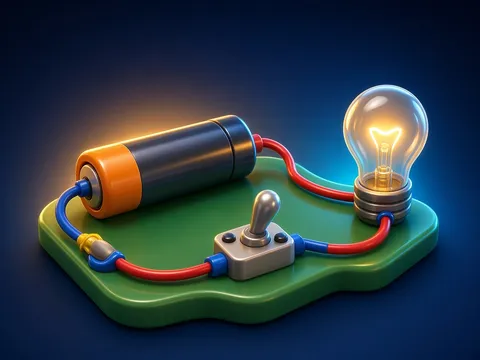
An electric circuit is a closed path that current flows around. A simple circuit has a power source (battery), wires, a device that uses the energy (bulb, motor, buzzer) and a switch. Current flows only when the circuit is closed: then the bulb lights. When the switch opens the circuit, the path is broken and the bulb goes out. A wire is metal inside (usually copper) and plastic outside. Metal lets current through well, so it is a conductor. Plastic, rubber, glass and dry wood do not, so they are insulators. A circuit is drawn on paper with symbols as a circuit diagram. Safety: in class we only use small batteries. A wall socket is very dangerous: never push anything into it and never touch electrical devices with wet hands.
 What the book shows

In grade 5 technology pupils learn to work with wood and thin sheet metal, build a simple electric circuit and make a small project. Each lesson has safety rules, a sequence of steps and a practical task.
Textbook link:
This is not the textbook’s text but a short description of the topic. Check the exact page in your own textbook.
 The lesson step by step
- 1
Warm-up5 min
Why does a torch light up?
- 2
New topic10 min
Parts of a circuit.
- 3
Practice10 min
Closed and open circuits.
- 4
Game10 min
Conductors and insulators.
- 5
Wrap-up5 min
Building a circuit and drawing its diagram.
 Let’s understand
For the student Simple language
| Part | Job |
|---|---|
| battery | supplies current |
| wire | carries current |
| bulb | gives light |
| switch | opens and closes the circuit |
 For the parent
How to help
- Go over electrical safety at home: nothing in sockets, no wet hands on devices, no damaged cables.
 For the teacher
 Lesson goals
- Know the parts of a simple circuit (power source, wire, bulb, switch), tell a closed circuit from an open one, tell conductors from insulators, and safely build a circuit with a battery.
How to teach it
- Demonstration, working from an instruction card, practical pair work, a project
 Differentiation
- Weaker pupils work from a ready outline; stronger pupils make their own design
 Questions for the class
- How does a bulb light up?
 How to check
The pupil names the parts, explains closed and open circuits, builds a battery circuit and states the safety rules.
 Scientific Scientific language
Why is a wire coated in plastic?
Plastic is an insulator: it stops current passing to our hands and other things.
Why is water dangerous?
Water with dissolved salts conducts current, so never touch electricity with wet hands.
Self-study
Step by step
- I named the parts of a circuit.
- I told closed from open.
- I sorted conductors and insulators.
- I built a circuit with a battery.
Going deeper
 Scientific language: for older students, parents and teachers.
A torch contains a simple circuit too: batteries, a switch, a bulb and metal strips joining them. Try opening one to find the parts.
 Play and check
Conductor or insulator?
 How to write it down
- Draw a diagram of a circuit with a battery, a switch and a bulb.
- Write what happens when the switch is open.
How the classwork looks in the notebook
Sample: the date and heading follow this country’s notebook rules.
 Watch out: common mistakes
 Where it helps in life
- Project: a bookend
 At home
Core
- List 5 electrical devices with a switch at home.
Extra ⭐
- List 3 conductors and 3 insulators.
How to do it
- Work with a grown-up watching.
- Tidy up afterwards.
Answers for parents
Examples: a lamp, a hairdryer, a computer, a kettle, a TV. Conductors: copper, aluminium, iron. Insulators: plastic, rubber, glass.
Step-by-step homework solution — Show the solution (try it yourself first)
Think
- Two bulbs are connected one after the other and one blows. Why does the other go out too? The only path for the current went through the blown bulb; the path is broken, so the circuit is open.
How the homework looks in the notebook
Sample: the date and heading follow this country’s notebook rules.

 About cookies