


Primitive society


 About this lesson
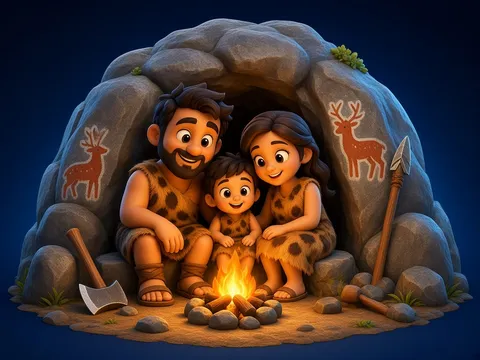
Primitive society is the longest period of human history, lasting until states and writing appeared. It is divided into periods by the material people made tools from. The Stone Age has three stages. In the Palaeolithic (Old Stone Age) people lived by hunting and gathering, settled in caves, made rough stone tools and learned to keep fire going. Azerbaijan’s most famous site of this age is Azykh Cave in the Fuzuli district, where people lived more than a million years ago. In 1968 the archaeologist Mammadali Huseynov found the jawbone of an ancient human there, later called “Azykhanthropus”. Taglar and Damjili caves are also early sites. In the Mesolithic (Middle Stone Age) the bow and arrow were invented and fishing developed; the Gobustan rock carvings show life in this and later periods. In the Neolithic (New Stone Age) people began farming and herding, settled down and made clay pots — the “Neolithic revolution”. The settlements of Shomutepe and Goytepe belong to this period. Then came the Eneolithic (Copper-Stone), Bronze and Iron Ages: metal tools raised productivity, and crafts and trade appeared. Society changed too: at first people lived in communities of relatives, gathering and sharing everything together; later clans and tribes formed. In the metal ages surplus produce, inequality of property and the power of tribal chiefs appeared — paving the way for the first states.
 What the book shows

In grade 6 the History of Azerbaijan course starts with key historical ideas and units of time, then covers primitive society, the first states, Manna, Atropatene and Albania, the rise of feudal relations and the Sasanian period. Read the topic in the textbook, look at the maps and pictures, and put the dates on a timeline.
Textbook link:
This is not the textbook’s text but a short description of the topic. Check the exact page in your own textbook.
 The lesson step by step
- 1
Warm-up5 min
A fire outside a cave.
- 2
New topic10 min
Stages of the Stone Age.
- 3
Practice10 min
Early sites in Azerbaijan.
- 4
Game10 min
Metal ages and society.
- 5
Wrap-up5 min
Working with finds.
 Let’s understand
For the student Simple language
| Period | Way of life | Site |
|---|---|---|
| Palaeolithic | hunting, gathering, fire | Azykh, Taglar |
| Mesolithic | bow and arrow, fishing | Gobustan |
| Neolithic | farming, herding, pottery | Shomutepe, Goytepe |
| Bronze and Iron | metal tools, crafts | Kultepe and others |
 For the parent
How to help
- Browse the website of the National Museum of History of Azerbaijan or the Gobustan reserve together and discuss pictures of ancient tools.
 For the teacher
 Lesson goals
- Know the periods of primitive society (Stone, Copper-Stone, Bronze, Iron Ages) in order, locate the main early human sites in Azerbaijan on a map, and explain how people’s economy, tools and social life changed.
How to teach it
- Working with sources and maps, timelines, discussion, mini-project
 Differentiation
- Weaker pupils work with key dates and pictures; stronger pupils compare sources and write their own conclusion
 Questions for the class
- What changed early people’s lives most: fire, the bow, or farming?
 How to check
The pupil names the periods in order, locates key sites and explains how the economy, tools and society changed.
 Scientific Scientific language
Bronze
Bronze is an alloy of copper and tin and is harder than copper.
UNESCO
The Gobustan Rock Art Cultural Landscape was added to the UNESCO World Heritage List in 2007.
Self-study
Step by step
- I named the periods in order.
- I found the sites on a map.
- I explained changes in the economy.
- I explained the move from community to tribe.
Going deeper
 Scientific language: for older students, parents and teachers.
Azykh Cave is considered one of the oldest human sites in the world; the hearth remains found there show people used fire very early.
 Play and check
Which period is this from?
 How to write it down
- List the periods in order with the main innovation of each.
- Mark Azykh, Taglar, Gobustan, Shomutepe and Goytepe on an outline map.
- Explain why the “Neolithic revolution” is called a revolution.
How the classwork looks in the notebook
Sample: the date and heading follow this country’s notebook rules.
 Watch out: common mistakes
 Where it helps in life
- Early states
 At home
Core
- Draw one of the Gobustan rock carvings and write 3 sentences on what it shows.
Extra ⭐
- Compare a day in the life of a hunter and of a farmer.
How to do it
- Put the dates on a timeline.
- Retell the topic to a grown-up.
Answers for parents
The Neolithic revolution: people moved from gathering what nature provided to producing food themselves; settled life, food stores and population growth followed — a complete change in the way of life.
Step-by-step homework solution — Show the solution (try it yourself first)
Working with a source
- At a settlement archaeologists found grain, a stone mortar, clay pots and bones of farm animals. Which period is it? Farming (grain, mortar), herding (farm animals) and pottery (clay pots) point to the Neolithic or later; people were living in one place.
How the homework looks in the notebook
Sample: the date and heading follow this country’s notebook rules.

 About cookies