


Early states


 About this lesson
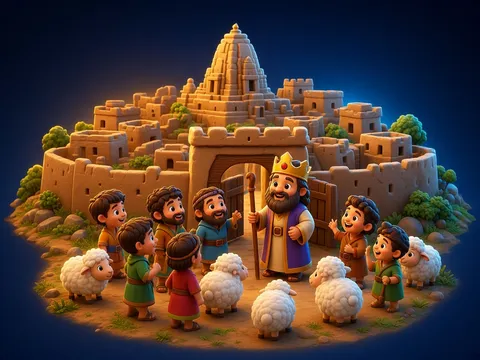
As surplus produce and inequality grew within tribes, the chiefs’ power increased, and eventually a state emerged. The main signs of a state are a defined territory, a supreme ruler, an army, officials, taxes and laws. The first states on Azerbaijani lands appeared in the 3rd millennium BC around Lake Urmia. We know about them mainly from the written sources of neighbouring Sumer and Akkad. Aratta is thought to be one of the oldest. Sumerian epics describe Aratta as a rich land that traded and competed with the Sumerian city of Uruk, sending it precious stones and metals. The Lullubi state lay south-west of Lake Urmia; the Lullubi fought the kings of Akkad, and a rock carving and inscription of the Lullubi ruler Annubanini survive. The Guti (Kuti) state lay south of Lake Urmia. In the 22nd century BC the Guti defeated Akkad and ruled Mesopotamia for about a hundred years, until the united Sumerian cities drove them out. In the 2nd millennium BC the Su and Turukki tribal unions were also known. These states relied on farming, herding and crafts, and both traded and fought with their neighbours.
 What the book shows

In grade 6 the History of Azerbaijan course starts with key historical ideas and units of time, then covers primitive society, the first states, Manna, Atropatene and Albania, the rise of feudal relations and the Sasanian period. Read the topic in the textbook, look at the maps and pictures, and put the dates on a timeline.
Textbook link:
This is not the textbook’s text but a short description of the topic. Check the exact page in your own textbook.
 The lesson step by step
- 1
Warm-up5 min
An ancient walled town.
- 2
New topic10 min
How a state arises.
- 3
Practice10 min
Aratta and Lullubi.
- 4
Game10 min
The Guti and tribal unions.
- 5
Wrap-up5 min
Source analysis.
 Let’s understand
For the student Simple language
| State | Where | Known for |
|---|---|---|
| Aratta | around Lake Urmia | wealth, trade with Uruk |
| Lullubi | south-west of Urmia | Annubanini’s rock inscription |
| Guti | south of Urmia | beat Akkad, ruled ~100 years |
| Su, Turukki | Urmia basin | tribal unions, 2nd millennium BC |
 For the parent
How to help
- Find Lake Urmia and Mesopotamia (the Tigris and Euphrates) on a map together and estimate the distance between them.
 For the teacher
 Lesson goals
- Know the main signs of a state, place the first states on Azerbaijani lands (Aratta, Lullubi, Guti) in time and space, and explain their links with neighbouring Mesopotamia.
How to teach it
- Working with sources and maps, timelines, discussion, mini-project
 Differentiation
- Weaker pupils work with key dates and pictures; stronger pupils compare sources and write their own conclusion
 Questions for the class
- When does a tribe become a state?
 How to check
The pupil lists the signs of a state, places Aratta, Lullubi and Guti in time and space, and explains their links with Mesopotamia.
 Scientific Scientific language
Cuneiform
Sumerians pressed wedge-shaped signs into clay tablets with a reed; our information on Aratta comes from these texts.
Rock inscriptions
Inscriptions carved into rock can survive for thousands of years.
Self-study
Step by step
- I know the signs of a state.
- I named the first states.
- I showed them on a map.
- I explained the links with Mesopotamia.
Going deeper
 Scientific language: for older students, parents and teachers.
Scholars still debate exactly where Aratta was; historians compare sources to support their views.
 Play and check
Which state does it describe?
 How to write it down
- Write the 5 signs of a state.
- Make a table on Aratta, Lullubi and Guti: place, period, source, famous fact.
- Why do we learn about these states from neighbouring peoples’ sources?
How the classwork looks in the notebook
Sample: the date and heading follow this country’s notebook rules.
 Watch out: common mistakes
 Where it helps in life
- The state of Manna
 At home
Core
- Mark Lake Urmia, the lands of Aratta, Lullubi and Guti, and Sumer on an outline map.
Extra ⭐
- Write 5 sentences on “When the Guti ruled Mesopotamia”.
How to do it
- Put the dates on a timeline.
- Retell the topic to a grown-up.
Answers for parents
Signs: territory, ruler, army, officials, taxes and laws. Few written sources of these states themselves have reached us, while Sumer and Akkad left many clay-tablet texts that also describe their neighbours.
Step-by-step homework solution — Show the solution (try it yourself first)
Let’s analyse a source
- In a Sumerian epic the ruler of Uruk sends an envoy to Aratta demanding precious stones and metals and offering grain in return. What does this tell us? Aratta had mountain wealth — stone and metal — while Sumer had plenty of grain, so the two lands traded and competed.
How the homework looks in the notebook
Sample: the date and heading follow this country’s notebook rules.

 About cookies