


Literature as a source of joy and knowledge


 About this lesson
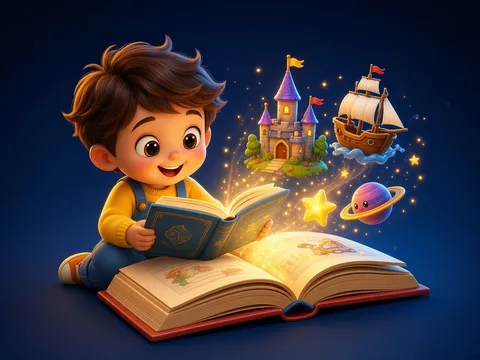
When we read a literary work we gain two things. First, enjoyment: exciting events, vivid characters and beautiful words and descriptions move us, delight us and make us think. The ability to feel a work’s beauty is called aesthetic taste, and it grows the more you read. Second, knowledge: a book takes us to other times, countries and lives, and tells us about a people’s customs, history and nature. Reading epics (dastans) we learn the heroic ideals of long ago; from novels we learn how people live in other countries. But a literary work is not a textbook: the writer gives knowledge through characters and events, and the reader draws the conclusion. Literature also shapes character: discussing heroes’ actions, we think about what is right and wrong. A good reader reads carefully, looks up hard words, notes events and characters and backs up their own view. A reading diary helps: write the title, author, a short summary, a favourite passage and your opinion.
 What the book shows

The grade 6 literature textbook includes folk literature (epics, legends), stories and poems by Azerbaijani and world writers, extracts from novels, and lessons on writing compositions and essays. Read the work in the textbook first, note the events and characters, then answer the questions and give reasons for your opinion.
Textbook link:
This is not the textbook’s text but a short description of the topic. Check the exact page in your own textbook.
 The lesson step by step
- 1
Warm-up5 min
A world rising from a book.
- 2
New topic10 min
Enjoyment and taste.
- 3
Practice10 min
Knowledge and values.
- 4
Game10 min
Good readers and diaries.
- 5
Wrap-up5 min
Analysing a pupil’s note.
 Let’s understand
For the student Simple language
| What a book gives | How | Example |
|---|---|---|
| enjoyment | events, characters, language | an exciting plot |
| knowledge | other times and places | epic, novel |
| values | heroes’ deeds | good and evil |
| reading skill | reading diary | title, author, view |
 For the parent
How to help
- Have a five-minute family chat about everyone’s favourite book: what did you learn, what did you enjoy?
 For the teacher
 Lesson goals
- Explain with examples how a literary work gives both enjoyment and knowledge, back up your impression of a book, and learn to keep a reading diary.
How to teach it
- Expressive reading, text questions, character analysis, reading in parts, creative writing
 Differentiation
- Weaker pupils retell with a plan and key words; stronger pupils write their own text
 Questions for the class
- What does reading give us?
 How to check
The pupil explains with examples how literature gives enjoyment and knowledge, backs up impressions and keeps a reading diary.
 Scientific Scientific language
Reading and the brain
Reading grows your vocabulary and trains you to keep your attention on one subject for a long time.
Libraries
School and town libraries let you read for free, and the catalogue helps you find a book.
Self-study
Step by step
- I gave examples of enjoyment and knowledge.
- I backed up my impression.
- I started a reading diary.
- I looked up hard words.
Going deeper
 Scientific language: for older students, parents and teachers.
Book printing spread in Azerbaijan in the 19th century; today the National Library is the country’s largest.
 Play and check
What does this give the reader?
 How to write it down
- Write the title and author of the last book you read.
- Write one thing you enjoyed and one thing you learned from it.
- Draw a reading-diary table: title, author, short summary, favourite passage, my view.
How the classwork looks in the notebook
Sample: the date and heading follow this country’s notebook rules.
 Watch out: common mistakes
 Where it helps in life
- The Koroghlu epic: “Ali kishi”
 At home
Core
- Keep a reading diary for a week: note how much you read each day and one interesting sentence.
Extra ⭐
- Recommend a book to a classmate in three sentences.
How to do it
- Read the work aloud.
- Copy your favourite part and explain why you chose it.
Answers for parents
Answers are personal; what matters is that each view comes with a reason.
Step-by-step homework solution — Show the solution (try it yourself first)
Let’s analyse
- A pupil writes: “I read the epic. The hero’s courage thrilled me (enjoyment). I learned how precious a horse was to people long ago (knowledge). I thought about not putting up with injustice (values).” One book helped in three ways.
How the homework looks in the notebook
Sample: the date and heading follow this country’s notebook rules.

 About cookies