


The land of the pyramids: ancient Egypt

 About this lesson
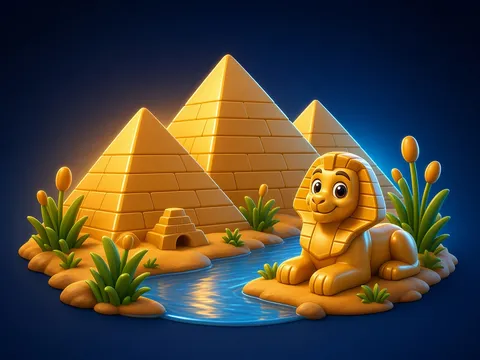
Ancient Egypt grew up in north-east Africa, in the valley of the river Nile. Desert lay all around, so life was concentrated along the river. Every year the Nile flooded, and when the water went down it left fertile silt on the fields. That is why the ancient Greek historian Herodotus called Egypt “the gift of the Nile”. The Egyptians dug canals and built dams to share water across their fields; this work needed many people working together and helped a strong government to develop. Around 3000 BC Upper and Lower Egypt were joined into one state. The country was ruled by the pharaoh, who was believed to be the son of a god; the land, the army and the officials all answered to him. The Egyptians believed in life after death, so they preserved the bodies of the dead in a special way, turning them into mummies. Huge stone tombs, the pyramids, were built for the pharaohs. The largest is the pyramid of Khufu (Cheops) at Giza, built in the 3rd millennium BC; it is the only one of the seven wonders of the ancient world that still stands. Beside the pyramids rises the Great Sphinx, with a lion’s body and a human head. The Egyptians worshipped many gods; the sun god Ra, later Amun-Ra, was the chief god. They invented picture writing, hieroglyphs, and made a writing material, papyrus, from reeds that grew along the Nile. The hieroglyphs were finally read in 1822 by the French scholar Champollion with the help of the Rosetta Stone. The Egyptians drew up a calendar of 365 days and gathered a good deal of knowledge in geometry, astronomy and medicine.
 What the book shows

In grade 6 the World History course covers the civilisations of the ancient East and West: Egypt, Mesopotamia, Iran, Great Turkestan, China, Greece and Rome. Read the topic in the textbook, look at the map, put the dates on a timeline and compare the civilisations with each other.
Textbook link:
This is not the textbook’s text but a short description of the topic. Check the exact page in your own textbook.
 The lesson step by step
- 1
Warm-up5 min
The Nile floods and the fields turn green.
- 2
New topic10 min
The pharaoh and his state.
- 3
Practice10 min
Pyramids and mummies.
- 4
Game10 min
Hieroglyphs and papyrus.
- 5
Wrap-up5 min
Reading a wall painting.
 Let’s understand
For the student Simple language
| Term | Meaning |
|---|---|
| pharaoh | ruler of Egypt, “son of a god” |
| pyramid | the pharaoh’s stone tomb |
| mummy | a specially preserved body |
| hieroglyph | a picture-writing sign |
| papyrus | writing material made from reeds |
 For the parent
How to help
- Write your names together in “hieroglyphs”: pick a little picture for each letter, then talk about why the Egyptians wrote this way.
 For the teacher
 Lesson goals
- Explain how Egyptian civilisation depended on the Nile and describe the pharaoh’s power, the pyramids, Egyptian beliefs, writing and knowledge.
How to teach it
- Working with sources and maps, timelines, comparison tables, discussion
 Differentiation
- Weaker pupils work with key dates, names and pictures; stronger pupils compare civilisations and write their own conclusion
 Questions for the class
- What skills of the ancient Egyptians do the pyramids show?
 How to check
The pupil explains the role of the Nile, describes the pharaoh’s power, pyramids and mummies, and lists Egyptian writing and achievements.
 Scientific Scientific language
The Rosetta Stone
It carried the same text written three ways: in hieroglyphs, in demotic script and in Greek. Knowing the Greek helped scholars crack the hieroglyphs.
Mummies today
Scientists study mummies with X-rays and CT scans without unwrapping them.
Self-study
Step by step
- I explained the role of the Nile.
- I described the pharaoh’s power.
- I know why the pyramids were built.
- I listed Egyptian achievements.
Going deeper
 Scientific language: for older students, parents and teachers.
Archaeologists have found a workers’ village and graves showing that the pyramids were built mainly by paid and fed teams of workers, not by slaves.
 Play and check
Which part of Egyptian life does it belong to?
 How to write it down
- Why did Herodotus call Egypt “the gift of the Nile”? Write 3 sentences.
- List what the pharaoh’s power rested on.
- Write 4 Egyptian achievements.
How the classwork looks in the notebook
Sample: the date and heading follow this country’s notebook rules.
 Watch out: common mistakes
 Where it helps in life
- History begins at Sumer
 At home
Core
- Write a short story about building a pyramid: who moved the stones, and how?
Extra ⭐
- Draw a map of Egypt: the Nile, the delta, Giza and the Mediterranean.
How to do it
- Put the dates on a timeline.
- Retell the topic to a grown-up.
Answers for parents
Egypt is desert; farming was possible only thanks to the water and silt brought by the Nile’s flood. Without the river there would have been no civilisation.
Step-by-step homework solution — Show the solution (try it yourself first)
Working with a source
- An Egyptian wall painting shows people harvesting grain while a scribe writes on papyrus. What does it show? Farming (the harvest) was the basis of Egypt’s economy; the scribe is recording the crop, so the state collected taxes and writing was needed to run it.
How the homework looks in the notebook
Sample: the date and heading follow this country’s notebook rules.

 About cookies