


History begins at Sumer


 About this lesson
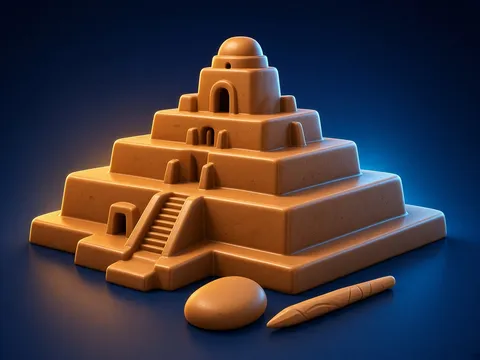
Mesopotamia, “the land between the rivers”, is the plain between the Tigris and the Euphrates. It had little stone or timber, but the silt brought by the rivers made the soil fertile. There was little rain, so people dug canals to water their fields. The Sumerians, who lived in the south of Mesopotamia, created one of the world’s oldest civilisations. In the late 4th and the 3rd millennium BC, city-states such as Ur, Uruk and Lagash appeared here. Each city had its own ruler, army and chief god, and the cities often fought each other over water and land. In the centre of each city rose a stepped temple, the ziggurat. Because stone was scarce, the Sumerians built houses and temples of mud brick and baked brick. Their most important invention was writing. At first they scratched pictures on wet clay tablets to keep count of crops and animals. Later the pictures became simpler and turned into wedge-shaped marks pressed in with a reed stylus; this writing is called cuneiform. The tablets were dried or baked, so thousands have survived to this day. That is why people say written history begins at Sumer. The Sumerians are also credited with using the wheel and the potter’s wheel. Their counting system based on 60 still lives on: there are 60 minutes in an hour, 60 seconds in a minute and 360 degrees in a circle. The Epic of Gilgamesh, created in Sumer, is one of the oldest works of literature in the world. In the 24th century BC Sargon, ruler of Akkad, conquered the Sumerian cities and united most of Mesopotamia in one state.
 What the book shows

In grade 6 the World History course covers the civilisations of the ancient East and West: Egypt, Mesopotamia, Iran, Great Turkestan, China, Greece and Rome. Read the topic in the textbook, look at the map, put the dates on a timeline and compare the civilisations with each other.
Textbook link:
This is not the textbook’s text but a short description of the topic. Check the exact page in your own textbook.
 The lesson step by step
- 1
Warm-up5 min
A plain between two rivers.
- 2
New topic10 min
City-states and ziggurats.
- 3
Practice10 min
From picture to wedge.
- 4
Game10 min
Sumerian ideas we still use.
- 5
Wrap-up5 min
Reading a clay tablet.
 Let’s understand
For the student Simple language
| Invention | Where we see it today |
|---|---|
| cuneiform | writing itself, written sources |
| the wheel | carts, bikes, cars |
| counting in 60s | 60 minutes, 360° |
| ziggurat | stepped buildings |
| Epic of Gilgamesh | the oldest literature |
 For the parent
How to help
- Press “cuneiform” marks into plasticine with a matchstick. Write and read a secret message together.
 For the teacher
 Lesson goals
- Describe the land of Mesopotamia and the Sumerian city-states, explain how cuneiform writing arose and why it matters to history, and list Sumerian inventions.
How to teach it
- Working with sources and maps, timelines, comparison tables, discussion
 Differentiation
- Weaker pupils work with key dates, names and pictures; stronger pupils compare civilisations and write their own conclusion
 Questions for the class
- Without writing, what would we not know about ancient people?
 How to check
The pupil locates Mesopotamia, describes the city-states, explains how cuneiform arose and lists Sumerian inventions.
 Scientific Scientific language
Clay is the best archive
Paper and leather rot, but baked clay lasts for thousands of years. When a palace burned, its tablets became even harder.
The oldest “receipts”
Many of the first Sumerian texts are accounts: how many sheep, how many sacks of grain.
Self-study
Step by step
- I located Mesopotamia.
- I know what a city-state is.
- I explained how cuneiform began.
- I listed Sumerian inventions.
Going deeper
 Scientific language: for older students, parents and teachers.
Sumerian is not related to any known language; scholars study it through the tablets and through word lists made in later times.
 Play and check
Egypt or Sumer?
 How to write it down
- Draw an outline of Mesopotamia and mark the Tigris, Euphrates, Ur and Uruk.
- Write the stages of how cuneiform developed.
- List 3 things we still have from Sumer.
How the classwork looks in the notebook
Sample: the date and heading follow this country’s notebook rules.
 Watch out: common mistakes
 Where it helps in life
- Other states of Mesopotamia
 At home
Core
- Write 5–6 sentences about a day at a Sumerian school.
Extra ⭐
- Compare Egypt and Sumer in a table: landscape, writing, buildings.
How to do it
- Put the dates on a timeline.
- Retell the topic to a grown-up.
Answers for parents
Clay tablets do not burn or rot, so thousands of Sumerian texts survive; where there are written sources, historians can learn events, names and dates.
Step-by-step homework solution — Show the solution (try it yourself first)
Working with a source
- A clay tablet shows 5 sheep and some signs beside them. What is it? The earliest writing was accounting: a temple or palace recording how many animals it owned. So writing first arose for running things and keeping count.
How the homework looks in the notebook
Sample: the date and heading follow this country’s notebook rules.

 About cookies