


Other states of Mesopotamia: Babylon and Assyria


 About this lesson
After Sumer and Akkad, new powerful states arose in Mesopotamia. The city of Babylon on the Euphrates rose to power in the 18th century BC under King Hammurabi. Hammurabi united most of Mesopotamia and collected a single set of laws for the whole country. The laws were carved in cuneiform on a large basalt pillar; at its top Hammurabi is shown standing before Shamash, god of the sun and of justice. The laws covered trade, renting land, family life, crimes and punishments. Punishments were harsh, often based on “an eye for an eye”, and they also depended on who a person was, free or slave. Even so, a written law meant rules everyone could know, and it limited judges acting as they pleased. The pillar is now kept in the Louvre museum in Paris. In the north of Mesopotamia, on the Tigris, lay Assyria (Ashur). The Assyrians built a powerful army: war chariots, cavalry, iron weapons and siege engines for breaking down city walls. In the 8th–7th centuries BC Assyria conquered a vast area from Egypt to Iran; conquered peoples paid heavy tribute and rebels were punished cruelly. The capital was Nineveh. In the 7th century BC King Ashurbanipal created a huge library at Nineveh holding thousands of clay tablets: prayers, epics, word lists, and medical and astronomical texts. The famous copy of the Epic of Gilgamesh was found in this library. In 612 BC the joint forces of Media and Babylon destroyed Nineveh, and Assyria fell. After that the New Babylonian kingdom rose. King Nebuchadnezzar II (6th century BC) made Babylon a magnificent city: the Ishtar Gate, faced with blue glazed tiles, was built, and ancient Greek writers counted the Hanging Gardens of Babylon among the seven wonders of the world. In 539 BC Babylon was taken by the Iranian king Cyrus II.
 What the book shows

In grade 6 the World History course covers the civilisations of the ancient East and West: Egypt, Mesopotamia, Iran, Great Turkestan, China, Greece and Rome. Read the topic in the textbook, look at the map, put the dates on a timeline and compare the civilisations with each other.
Textbook link:
This is not the textbook’s text but a short description of the topic. Check the exact page in your own textbook.
 The lesson step by step
- 1
Warm-up5 min
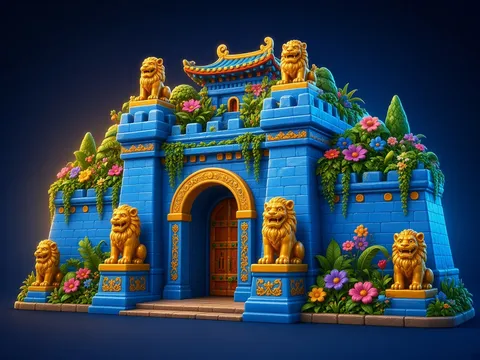
A blue gate with lions.
- 2
New topic10 min
Hammurabi and his laws.
- 3
Practice10 min
The Assyrian army.
- 4
Game10 min
The Nineveh library.
- 5
Wrap-up5 min
Reading a law.
 Let’s understand
For the student Simple language
| State | Time | Famous for |
|---|---|---|
| Babylon (Hammurabi) | 18th c. BC | written laws |
| Assyria | 8th–7th c. BC | army, Nineveh library |
| New Babylon | 7th–6th c. BC | Ishtar Gate, Hanging Gardens |
 For the parent
How to help
- Write your family rules together as a “law pillar”: each rule and what happens if it is broken. Discuss whether they are fair.
 For the teacher
 Lesson goals
- Place the rise of Babylon and Assyria in time and space, and explain the importance of Hammurabi’s laws, Assyria’s military power and the library of Ashurbanipal.
How to teach it
- Working with sources and maps, timelines, comparison tables, discussion
 Differentiation
- Weaker pupils work with key dates, names and pictures; stronger pupils compare civilisations and write their own conclusion
 Questions for the class
- Why does it matter that a law is written down?
 How to check
The pupil places Babylon and Assyria in time and space and explains Hammurabi’s laws, Assyria’s power and the value of the library.
 Scientific Scientific language
An ancient library catalogue
Tablets in Ashurbanipal’s library were arranged by subject, and some ended with the owner’s name.
Blue bricks
The Ishtar Gate got its bright colour from a glaze baked onto the bricks.
Self-study
Step by step
- I located Babylon and Assyria.
- I explained why Hammurabi’s laws matter.
- I described Assyria’s power.
- I talked about the Nineveh library.
Going deeper
 Scientific language: for older students, parents and teachers.
It is still not known exactly where the Hanging Gardens were; archaeologists have not found clear traces of them at Babylon, so scholars hold different views.
 Play and check
Babylon or Assyria?
 How to write it down
- Write 3 good and 2 bad points about Hammurabi’s laws.
- List the strengths of the Assyrian army.
- Mark the 18th century BC, 612 BC and 539 BC on a timeline.
How the classwork looks in the notebook
Sample: the date and heading follow this country’s notebook rules.
 Watch out: common mistakes
 Where it helps in life
- The fire worshippers
 At home
Core
- Write a 5-point “class law” like Hammurabi’s and explain why it is fair.
Extra ⭐
- Make a tourist-guide page about Babylon.
How to do it
- Put the dates on a timeline.
- Retell the topic to a grown-up.
Answers for parents
A written law makes rules everyone can know: a judge cannot decide as he likes, and people know their rights and duties.
Step-by-step homework solution — Show the solution (try it yourself first)
Working with a source
- One law says, in short: if a builder’s house collapses and kills its owner, the builder himself is punished. What does this show? The state cared about the quality of building, and punishments were harsh, following “an eye for an eye”.
How the homework looks in the notebook
Sample: the date and heading follow this country’s notebook rules.

 About cookies