


The warriors of Tengri: Great Turkestan


 About this lesson
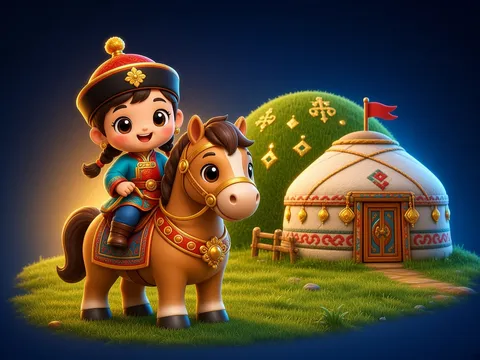
The ancient Turks lived in the heart of Eurasia, across a vast area stretching from the Kadyrgan (today’s Khingan) mountains in the east to the Ural mountains and the Caspian Sea in the west, and from Siberia in the north to China, Tibet and the Iranian plateau in the south. Later these lands were called Great Turkestan. Because of wars and droughts, Turkic tribes sometimes moved west, reaching as far as the Danube. The main occupation of the ancient Turks was nomadic herding: they kept horses, sheep, cattle and camels and moved with the seasons between summer and winter pastures. They lived in felt yurts that could be taken down and put up easily. The horse was the basis of Turkic life; the Turks are thought to have been among the first to tame horses, and were skilled mounted warriors. Yet in many parts of Turkestan people also lived settled lives, farming and working as craftsmen. The ancient Turks believed in Tengri, the Sky God, creator of the sky and the whole world, and so they are also called “the warriors of Tengri”. They imagined the sky as a tent and the Sun as a banner. The Turks buried their dead in kurgans, mounds of earth heaped over the grave; some kurgans have yielded gold ornaments, weapons and horses. In Kazakhstan, in the Issyk kurgan near Almaty, archaeologists found in 1969 the remains of a warrior buried in clothes decorated with thousands of small gold plates; he is known as the “Golden Man”. Ancient Greek writers called the nomadic tribes of these lands Scythians, and the Persians called them Saka. According to Herodotus, the Saka (Massagetae) queen Tomyris defeated the army of the Achaemenid king Cyrus II in 530 BC. Another ancient Turkic people were the Huns. At the end of the 3rd century BC Mete (Modu) united the Hun tribes and created a strong state. He organised the army on a decimal system, in units of ten, a hundred, a thousand and ten thousand (a tumen); this structure was kept in later Turkic states too. The Huns fought long wars with China, and Chinese rulers strengthened the Great Wall to protect themselves from their raids.
 What the book shows

In grade 6 the World History course covers the civilisations of the ancient East and West: Egypt, Mesopotamia, Iran, Great Turkestan, China, Greece and Rome. Read the topic in the textbook, look at the map, put the dates on a timeline and compare the civilisations with each other.
Textbook link:
This is not the textbook’s text but a short description of the topic. Check the exact page in your own textbook.
 The lesson step by step
- 1
Warm-up5 min
A rider and a yurt on the steppe.
- 2
New topic10 min
Great Turkestan on the map.
- 3
Practice10 min
Nomadic life and Tengri.
- 4
Game10 min
Kurgans, Saka and Huns.
- 5
Wrap-up5 min
Reading a kurgan find.
 Let’s understand
For the student Simple language
| Topic | Among the ancient Turks |
|---|---|
| economy | nomadic herding, and farming too |
| home | felt yurt |
| belief | Tengri, the Sky God |
| burial | kurgan; the “Golden Man” (Issyk) |
| army | decimal units: 10–100–1000–10,000 |
 For the parent
How to help
- Plan a year for a nomad family together: where did they live in spring, summer, autumn and winter, and why?
 For the teacher
 Lesson goals
- Show the borders of Great Turkestan, describe the nomadic way of life, beliefs and culture of the ancient Turks, and talk about the Scythians, the Saka, the Huns and the state of Mete.
How to teach it
- Working with sources and maps, timelines, comparison tables, discussion
 Differentiation
- Weaker pupils work with key dates, names and pictures; stronger pupils compare civilisations and write their own conclusion
 Questions for the class
- What would nomads’ lives have been like without the horse?
 How to check
The pupil locates Great Turkestan, describes nomadic life, belief in Tengri and kurgans, and talks about the Scythian-Saka and Hun states.
 Scientific Scientific language
The animal style
Scythian and Saka craftsmen made gold and bronze figures of deer, lions and horses; this art is called the “animal style”.
Frozen kurgans
In the Altai mountains ice formed inside some kurgans, so felt, carpets and cloth survived for thousands of years.
Self-study
Step by step
- I showed the borders of Great Turkestan.
- I described nomadic life.
- I know the basis of belief in Tengri.
- I explained Mete’s army.
Going deeper
 Scientific language: for older students, parents and teachers.
Historians hold different views on the language and origin of the Scythian, Saka and Hun tribes; Azerbaijani textbooks study them as ancient Turkic peoples.
 Play and check
Which part of nomadic life does it belong to?
 How to write it down
- Mark the borders of Great Turkestan on an outline map.
- Compare nomadic and settled life.
- Draw a diagram of Mete’s army.
How the classwork looks in the notebook
Sample: the date and heading follow this country’s notebook rules.
 Watch out: common mistakes
 Where it helps in life
- Where the Silk Road began
 At home
Core
- Write a short museum label about the “Golden Man” (4–5 sentences).
Extra ⭐
- Draw how a yurt is built and explain why it suited nomads.
How to do it
- Put the dates on a timeline.
- Retell the topic to a grown-up.
Answers for parents
The decimal system made the army quick to gather and easy to command: every ten, hundred and thousand had its own leader, so orders passed down fast.
Step-by-step homework solution — Show the solution (try it yourself first)
Working with a source
- A kurgan holds a warrior with a horse, a bow, gold ornaments and a pot. What does it show? The Turks believed in an afterlife and buried people with what they would need; the gold shows he was a noble, and the horse and weapons that he was a warrior.
How the homework looks in the notebook
Sample: the date and heading follow this country’s notebook rules.

 About cookies