


Where the Silk Road began: ancient China

 About this lesson
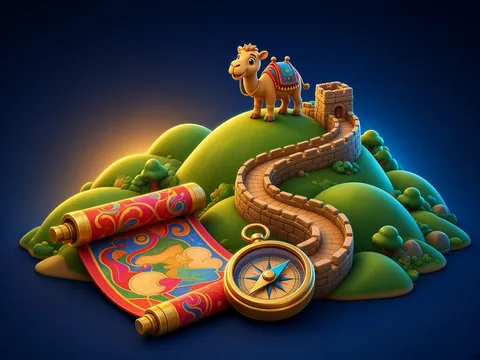
Chinese civilisation grew up in the valleys of the Huang He (Yellow River) and the Yangtze. The Huang He often flooded; its yellow silt made the fields fertile, but the floods also brought great disasters. The Chinese built dykes and canals and grew millet, and later rice. For a long time China was split into many kingdoms that fought each other. In 221 BC the ruler of the kingdom of Qin united them and called himself Qin Shi Huang, “the first emperor of Qin”. The European name of the country, China, is linked with the name Qin. Qin Shi Huang brought in one script, one currency and the same units of length and weight for the whole country, and built roads. To guard against raids by the nomadic Huns from the north, he joined up separate defensive walls and extended the building of the Great Wall. Beside the emperor’s tomb thousands of clay soldiers, the terracotta army, have been found; farmers digging a well came across them by chance in 1974. After Qin Shi Huang’s death the Han dynasty came to power (from 206 BC). Under the Han, China grew stronger and larger. In the 2nd century BC the emperor sent an envoy, Zhang Qian, to the lands of the west; after his journey, trade routes from China through Central Asia and Iran to the Mediterranean grew busy. Because silk was the main thing carried along them, they were later named the Silk Road. Along the road spread not only goods but also knowledge, religions and inventions. The Chinese long kept secret how to raise silkworms and weave silk. They invented paper, the compass and porcelain, and grew tea; gunpowder was invented later. China’s most famous thinker was Confucius (6th–5th centuries BC). He taught respect for parents and elders, good manners, learning, and a ruler’s care for his people; his teaching shaped Chinese culture for centuries.
 What the book shows

In grade 6 the World History course covers the civilisations of the ancient East and West: Egypt, Mesopotamia, Iran, Great Turkestan, China, Greece and Rome. Read the topic in the textbook, look at the map, put the dates on a timeline and compare the civilisations with each other.
Textbook link:
This is not the textbook’s text but a short description of the topic. Check the exact page in your own textbook.
 The lesson step by step
- 1
Warm-up5 min
A wall winding over the hills.
- 2
New topic10 min
Rivers and the first kingdoms.
- 3
Practice10 min
Qin Shi Huang and the Han.
- 4
Game10 min
The Silk Road and inventions.
- 5
Wrap-up5 min
Reading a find.
 Let’s understand
For the student Simple language
| Invention | Why it matters |
|---|---|
| silk | gave the Silk Road its name |
| paper | writing became cheaper and easier |
| compass | helped people find their way |
| porcelain | a valuable trade good |
| tea | a drink that spread worldwide |
 For the parent
How to help
- Look for Chinese inventions at home: paper, a compass, a porcelain cup, tea. Talk together about how they spread along the Silk Road.
 For the teacher
 Lesson goals
- Explain the geography of ancient China and how its state arose, and describe the age of Qin Shi Huang and the Han, the teaching of Confucius, Chinese inventions and the importance of the Silk Road.
How to teach it
- Working with sources and maps, timelines, comparison tables, discussion
 Differentiation
- Weaker pupils work with key dates, names and pictures; stronger pupils compare civilisations and write their own conclusion
 Questions for the class
- Which Chinese invention would be hardest to live without?
 How to check
The pupil locates China’s rivers and the Silk Road and explains the Qin and Han periods, Confucius and Chinese inventions.
 Scientific Scientific language
The terracotta army
The soldiers’ faces differ from each other; scholars think the craftsmen modelled them on different people.
The silkworm
Silk thread comes from the cocoon spun by a caterpillar that feeds on mulberry leaves.
Self-study
Step by step
- I located China’s rivers.
- I listed what Qin Shi Huang did.
- I explained why the Silk Road mattered.
- I know what Confucius taught.
Going deeper
 Scientific language: for older students, parents and teachers.
The name “Silk Road” was not used in ancient times; it was suggested in the 19th century by the German scholar Ferdinand von Richthofen.
 Play and check
Qin Shi Huang or the Han?
 How to write it down
- Draw the Silk Road on an outline map: China → Central Asia → Iran → the Mediterranean.
- Write 4 measures of Qin Shi Huang.
- Write 3 pieces of Confucius’s advice in your own words.
How the classwork looks in the notebook
Sample: the date and heading follow this country’s notebook rules.
 Watch out: common mistakes
 Where it helps in life
- The cradle of European culture
 At home
Core
- Write one page from the diary of a merchant travelling the Silk Road.
Extra ⭐
- Find out which branches of the Silk Road crossed Azerbaijan and write 3 sentences.
How to do it
- Put the dates on a timeline.
- Retell the topic to a grown-up.
Answers for parents
Along with goods, knowledge, religions, crafts and inventions travelled the road, and East and West came to know each other.
Step-by-step homework solution — Show the solution (try it yourself first)
Working with a source
- A piece of Chinese silk has been found in a grave from Roman times. What does it mean? Chinese goods passed from merchant to merchant across thousands of kilometres to reach Europe: the Silk Road linked distant lands through trade.
How the homework looks in the notebook
Sample: the date and heading follow this country’s notebook rules.

 About cookies