


Big and small

 About this lesson
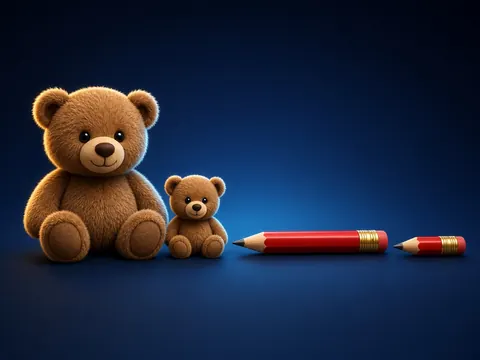
We compare things by size: big and small, long and short — the first step towards measuring.
 What the book shows

In the textbook this topic uses paired pictures: big and small animals, long and short objects. The child circles the bigger one or orders objects by size.
Textbook link: Grade 1 “Mathematics”, unit “Comparing objects”. The exact page will be given after checking the official edition.
This is not the textbook’s text but a short description of the topic. Check the exact page in your own textbook.
 The lesson step by step
- 1
Classroom hunt5 min
We find big and small things.
- 2
Lining up10 min
We compare pencils with their ends lined up.
On the board✏️ ━━━━━ ✏️ ━━ - 3
Ordering8 min
We order three objects from smallest to biggest.
On the board🍒 < 🍎 < 🍉 - 4
In the notebook8 min
We draw a big and a small square, a long and a short line.
- 5
Wrap-up4 min
We answer: “Compared with what?”
 Let’s understand
For the student Simple language
An elephant is big, a mouse is small. One pencil is long, the other is short. We compare things by putting them side by side and looking.
 elephantbig
 mousesmall
 ✏️ ↔ ✏️long and short
 For the parent
How to help
- Line up kitchen bowls from biggest to smallest.
- Compare shoes: whose shoe is longer?
- Ask “why?” and wait for a full-sentence answer.
What to check
- Does not mix up big/small and long/short.
- Puts three objects in order.
A 5-minute game
 For the teacher
 Lesson goals
- Compare objects by size.
- Use big, small, long and short correctly.
How to teach it
- Overlay and side-by-side: line up the starting edges.
- Order three objects from smallest to biggest.
 Differentiation
- For those who struggle: objects with an obvious difference.
- For fast finishers: put 5 objects in order.
 Questions for the class
- Is the pencil long or short? Compared with what?
- Is a big object always heavy?
 How to check
The child compares 5 of 6 pairs correctly and uses the right word.
 Scientific Scientific language
The core idea
Comparing by size comes before measuring. Children compare by eye, then by overlaying and lining up, and later move to units of measure.
Techniques
- Overlaying and lining up.
- Seriation: order 3–5 objects from smallest to biggest.
- Relativity: the same object can be bigger than one thing and smaller than another.
Assessment criterion
The child compares 5 of 6 pairs correctly and orders three objects.
Self-study
Step-by-step plan
- Look at the pictures and say which is bigger.
- Lay two pencils side by side with their ends lined up.
- In the game, choose the bigger one.
- In your notebook, draw a big and a small circle.
Check yourself: I can
- Find the big and the small object.
- Find the long and the short object.
 Terms in this lesson
Tap an underlined word — its meaning opens in the glossary.
- Side
- A straight edge of a shape.
- Difference
- The result of subtraction.
- Number
- Shows how many things there are.
Going deeper
 Scientific language: for older students, parents and teachers.
“Big” and “small” are relative: the same apple is small next to a watermelon and big next to a cherry. We always compare two things.
Research: Swiss psychologist Jean Piaget studied how children arrange objects by size — seriation. The skill usually develops in the preschool and early school years and supports number sense.
 Play and check
Which is bigger: the left one or the right one?
 How to write it down
- In a squared notebook, draw a big square 4 cells wide and a small one 1 cell wide.
- Below, draw a long line of 6 cells and a short line of 2 cells.
- Colour the big one blue and the small one red.
How the classwork looks in the notebook
Sample: the date and heading follow this country’s notebook rules.
 Watch out: common mistakes
 Where it helps in life
- Measuring: centimetres, rulers, kilograms.
- Comparing numbers: 7 > 3.
- Real life: clothing sizes, what fits in a box.
 At home
Core
- Find 3 things at home and order them from smallest to biggest.
- Draw a big and a small house in your notebook.
Challenge ⭐
- An apple is smaller than a watermelon but bigger than a cherry. Which is the smallest?
How to do it
- Take, for example, a spoon, a plate and a pot. Put the smallest on the left and the biggest on the right.
- When drawing houses, use 4 cells for the big one and 2 for the small one.
- Challenge: cherry < apple < watermelon, so the cherry is smallest.
Answers for parents
⭐ The cherry is smallest: cherry < apple < watermelon.
Step-by-step homework solution — Show the solution (try it yourself first)
Order 3 objects
- Place them side by side, smallest on the left and biggest on the right: spoon, plate, pot.
⭐ The smallest fruit
- The apple is smaller than the watermelon and bigger than the cherry: cherry < apple < watermelon. The cherry is smallest.
How the homework looks in the notebook
Sample: the date and heading follow this country’s notebook rules.

 About cookies