


Long and short


 About this lesson
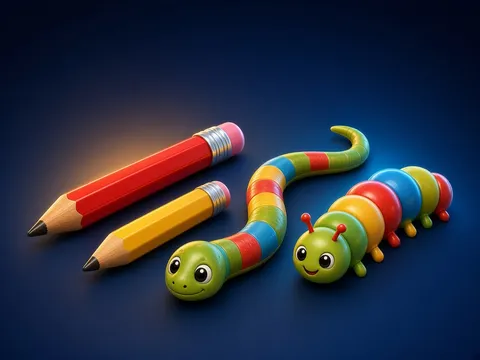
Put two things side by side with their ends lined up, and you can see which is longer.
 What the book shows

The textbook usually gives a picture example, a counting or comparing task and a short check. Talk about the picture first, then try the tasks with real objects.
Textbook link:
This is not the textbook’s text but a short description of the topic. Check the exact page in your own textbook.
 The lesson step by step
- 1
Mystery bag5 min
We take two things out and compare.
- 2
The rule10 min
We line up the ends.
- 3
Ordering10 min
We order three strips short to long.
- 4
In the notebook10 min
Strips on the grid.
- 5
Wrap-up5 min
Who is tallest?
 Let’s understand
For the student Simple language
The red pencil is longer than the yellow one. The yellow one is shorter.
Other words
tall — short (a tree and a bush), wide — narrow (a road and a path).
 For the parent
How to help
- Sort spoons and pens by length at home.
- Compare heights: who is taller?
- Ask “How did you check?” Did they line up the ends?
 For the teacher
 Lesson goals
- Direct comparison of length.
How to teach it
- Objects, strips, pairs.
 Differentiation
- Fast finishers: compare using a string.
 Questions for the class
- What if we don’t line up the ends?
 How to check
The pupil orders 3 things and explains how they checked.
 Scientific Scientific language
Comparing before measuring
Length starts with direct comparison: objects side by side, lined up at one end. Then indirect comparison (with string or a strip), and only later a unit (the centimetre). This order helps children see what measuring means.
Self-study
Step by step
- Put two things side by side.
- Line up one end.
- Look at the other end: longer, shorter or the same.
 Terms in this lesson
Tap an underlined word — its meaning opens in the glossary.
- Side
- A straight edge of a shape.
Going deeper
 Scientific language: for older students, parents and teachers.
Comparing length goes through three stages: direct (side by side), indirect (through a go-between such as string or a strip) and measuring (with an informal or standard unit). Grade 1 works mostly on the first two.
Children often say “big” for long, tall and wide alike. Precise words (long/short, tall/short, wide/narrow) build mathematical language.
 Play and check
Which is longer?
 How to write it down
- Draw two strips in your notebook: 2 squares and 5 squares long.
- Colour the long one red and the short one yellow.
How the classwork looks in the notebook
Sample: the date and heading follow this country’s notebook rules.
 Watch out: common mistakes
 Where it helps in life
- Centimetres: measuring with a ruler.
- In life: clothes, furniture, routes.
 At home
Core
- Line up 3 things at home by length and draw them.
Challenge ⭐
- Use a string to compare the width of a table and a door: which is longer?
How to do it
- Lay the things flat on a table.
- Push the ends against a book’s edge.
Answers for parents
Answers depend on the objects. Check: are the ends lined up?
Step-by-step homework solution — Show the solution (try it yourself first)
Order three things
- Compare two first, then hold the third against each.
How the homework looks in the notebook
Sample: the date and heading follow this country’s notebook rules.

 About cookies