


Word problems: facts and question


 About this lesson
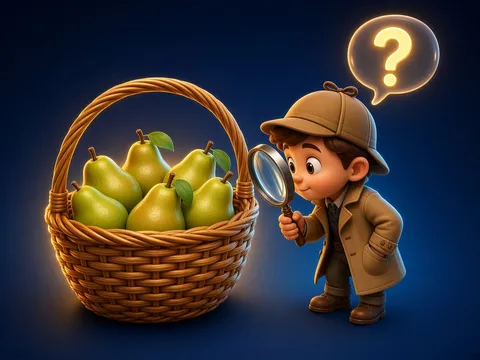
A word problem is a tiny story: the facts tell what we know and the question asks what to find.
 What the book shows

The textbook usually gives a picture example, a counting or comparing task and a short check. Talk about the picture first, then try the tasks with real objects.
Textbook link:
This is not the textbook’s text but a short description of the topic. Check the exact page in your own textbook.
 The lesson step by step
- 1
Detective5 min
A basket and a question.
- 2
Parts10 min
Facts, question, solution, answer.
- 3
Sorting10 min
Sorting sentences into facts and questions.
- 4
Making10 min
Writing a problem for a sum.
- 5
Wrap-up5 min
How do we write the answer?
 Let’s understand
For the student Simple language
Let’s investigate a problem like a little detective!
Facts: 4 pears, 3 more added.
Question: how many pears now?
Solution: 4 + 3 = 7.
Answer: 7 pears.
A problem has 4 parts: facts, question, solution, answer.
 For the parent
How to help
- Make up everyday problems: shop, kitchen, games.
- Ask “What do we know? What must we find?”
- Ask your child to draw the problem.
 For the teacher
 Lesson goals
- Problem structure; one-step problems.
How to teach it
- Acting out, drawing, short notes.
 Differentiation
- Fast finishers: write a problem.
 Questions for the class
- Is a text with no question a problem?
 How to check
The pupil separates facts and question and solves 2 of 3 problems.
 Scientific Scientific language
How a word problem is built
Word problems link maths to life. The child reads, separates facts from question and chooses the operation: “more, came, altogether” often mean adding; “gave, ate, left, remain” often mean subtracting. But key words can mislead, so the real skill is picturing the situation and drawing it.
Self-study
Step by step
- Read and picture the problem.
- Underline the facts once and the question twice.
- Draw it and write the sum.
- Say the answer in words: “7 pears”.
 Terms in this lesson
Tap an underlined word — its meaning opens in the glossary.
- Sum
- The result of addition.
- Difference
- The result of subtraction.
- Ones
- A single unit.
Going deeper
 Scientific language: for older students, parents and teachers.
The Hungarian-born mathematician George Pólya described four classic stages of problem solving: understand the problem, make a plan, carry it out and look back. For grade 1: read, picture, calculate, check.
A text without a question is not a problem, just a story. Discussing the difference helps children grasp the structure.
 Play and check
Is this a fact or the question?
 How to write it down
- Write it briefly: “Had: 4, added: 3, now: ?”
- Write the solution and the answer lines.
How the classwork looks in the notebook
Sample: the date and heading follow this country’s notebook rules.
 Watch out: common mistakes
 Where it helps in life
- Two-step problems (grade 2).
- Life: money, time, shopping.
 At home
Core
- Solve: There were 6 pencils in a box. 2 were taken. How many are left?
Challenge ⭐
- Make up a problem for 3 + 5.
How to do it
- Read the problem twice.
- Draw it, then write the sum.
Answers for parents
6 − 2 = 4. Answer: 4 pencils. ⭐ For example: “3 birds sat, 5 more came. How many now?”
Step-by-step homework solution — Show the solution (try it yourself first)
Draw it
- Draw each thing as a circle. Add new ones; cross out ones that leave.
How the homework looks in the notebook
Sample: the date and heading follow this country’s notebook rules.

 About cookies