


Making 10


 About this lesson
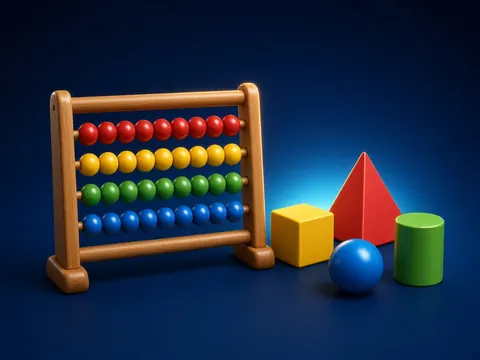
We find every way to split 10 into two parts: 1 + 9, 2 + 8, 3 + 7, 4 + 6, 5 + 5 — the “friends of ten”.
 What the book shows

In the textbook bonds to 10 are usually shown with a ten-frame, beads or “number houses”: 10 on the roof and two parts on each floor.
Textbook link: Grade 1 “Mathematics”, unit on adding and subtracting within 10. The exact page will be given after checking the official edition.
This is not the textbook’s text but a short description of the topic. Check the exact page in your own textbook.
 The lesson step by step
- 1
Finger game5 min
We fold some of our 10 fingers and count the rest.
On the board3 + 7 = 10 - 2
Ten-frame10 min
We count full and empty cells and write the pair.
On the board■■■■■■□□□□ 6 + 4 - 3
Number house8 min
10 on the roof, all pairs on the floors.
In the notebook1 + 9, 2 + 8, 3 + 7, 4 + 6, 5 + 5 - 4
Missing part8 min
Tasks like 10 = 7 + □.
On the board10 = 7 + 3 - 5
Wrap-up4 min
We say the friends of ten together.
 Let’s understand
For the student Simple language
You have 10 fingers. Let’s split them into two groups! Fold 3 fingers and 7 are left. So 3 + 7 = 10.
The friends of ten
 For the parent
How to help
- Play “friends of ten” on your fingers every day.
- Split 10 spoons between two plates and say it: “4 and 6 make 10”.
- If the child gets stuck, draw a ten-frame and count the empty cells.
What to check
- Says the bonds to 10 quickly.
- Solves tasks like 10 = 7 + □.
A 5-minute game
 For the teacher
 Lesson goals
- Know all the number bonds to 10.
- Find the missing part from the known part.
How to teach it
- A ten-frame: the empty cells show the other part.
- A string of 10 two-coloured beads: slide to find new bonds.
- Fingers: fold some of 10 and see how many are left.
 Differentiation
- For those who struggle: bonds to 5 first.
- For fast finishers: the strategy 8 + 5 = 8 + 2 + 3.
 Questions for the class
- Which number is 7’s friend to make ten?
- How many different pairs did we find?
 How to check
The child lists the bonds to 10 orally in a minute and finds a missing part.
 Scientific Scientific language
The core idea
A number bond writes a number as the sum of two parts. In 10 = a + b, as a grows, b shrinks by the same amount. Because addition is commutative, 3 + 7 and 7 + 3 are the same pair.
Techniques
- A ten-frame: full and empty cells show the two parts.
- Two-coloured beads and fingers.
- “Missing part”: 10 = 6 + □.
Assessment criterion
The child lists every bond to 10 and finds a missing part within 3 seconds.
Self-study
Step-by-step plan
- Split your 10 fingers into two groups.
- Write all the pairs in your notebook: from 1 + 9 to 9 + 1.
- In the game, find the sums that make 10.
Check yourself: I can
- Name the friends of ten.
- Find a missing part.
 Terms in this lesson
Tap an underlined word — its meaning opens in the glossary.
- Number
- Shows how many things there are.
- Sum
- The result of addition.
- Addition
- Putting two groups together to find the total.
- Subtraction
- Taking part away from a group.
Going deeper
 Scientific language: for older students, parents and teachers.
10 can be split into two non-zero whole numbers in 9 ordered ways (1 + 9 to 9 + 1); with 0 + 10 and 10 + 0 there are 11. Because order does not matter in addition, there are only 6 different pairs: 0 + 10, 1 + 9, 2 + 8, 3 + 7, 4 + 6, 5 + 5.
Why it matters: “making ten” makes bridging easy: 8 + 5 = 8 + 2 + 3 = 13 — the basis for place-value calculation later.
 Play and check
Work it out: does it make 10 or not?
 How to write it down
- Write the heading “Making 10”.
- Write in a column: 1 + 9, 2 + 8, 3 + 7, 4 + 6, 5 + 5.
- Next to each pair draw a ten-frame and colour it in two colours.
How the classwork looks in the notebook
Sample: the date and heading follow this country’s notebook rules.
 Watch out: common mistakes
 Where it helps in life
- Bridging ten: 8 + 5 = 8 + 2 + 3 = 13.
- Money: ways to make 10 coins’ worth.
- Subtraction: 10 − 4 = 6 because 4 + 6 = 10.
 At home
Core
- Write every bond to 10.
- Fill the box: 10 = 7 + □, 10 = □ + 2.
Challenge ⭐
- In how many ways can 10 apples go into two baskets (at least 1 in each)?
How to do it
- Start at 1: 1 + 9, then raise the first number by 1 and lower the second by 1: 2 + 8, 3 + 7…
- 10 = 7 + □: count from 7 to 10: 8, 9, 10 — three steps, so 3.
- Challenge: the first basket can hold 1 to 9 apples — 9 ways.
Answers for parents
10 = 7 + 3, 10 = 8 + 2. ⭐ 9 ways: 1 + 9, 2 + 8, … 9 + 1.
Step-by-step homework solution — Show the solution (try it yourself first)
All bonds to 10
- Start from 1 + 9: the first number goes up by 1, the second down by 1.
- 1 + 9, 2 + 8, 3 + 7, 4 + 6, 5 + 5, 6 + 4, 7 + 3, 8 + 2, 9 + 1.
10 = 7 + □, 10 = □ + 2
- From 7 to 10: 8, 9, 10 — that is 3. From 2 to 10 is 8 steps, so 8.
⭐ 10 apples, 2 baskets
- The first basket can hold 1, 2, … 9 apples — 9 ways.
How the homework looks in the notebook
Sample: the date and heading follow this country’s notebook rules.

 About cookies