


Ways to send information


 About this lesson
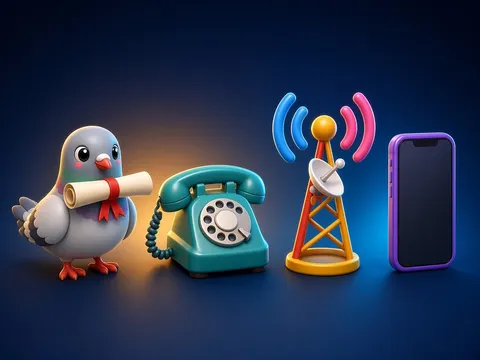
Sending information has three parts: the source (sender), the channel (the path) and the receiver. When you talk to a friend, you are the source, the air and sound are the channel, and your friend’s ear is the receiver. Long ago, news was carried by messengers, smoke signals and homing pigeons. Then came letters and the post. The telegraph was invented in the 19th century and the telephone in 1876. Radio and television came in the 20th century, and then the internet. Now a message reaches the other side of the world in seconds. “Noise” in the channel can spoil information: on a bad line the sound cuts out.
 What the book shows

In computer science the child first learns to think through unplugged games: recognising information, ordering steps and learning safety rules.
Textbook link:
This is not the textbook’s text but a short description of the topic. Check the exact page in your own textbook.
 The lesson step by step
- 1
Warm-up5 min
Broken telephone.
- 2
New topic10 min
Three parts.
- 3
Practice10 min
Timeline.
- 4
Game10 min
Old and new.
- 5
Wrap-up5 min
Writing a letter.
 Let’s understand
For the student Simple language
| Way | What it sends | Speed |
|---|---|---|
| 🕊️ pigeon, messenger | a letter | days |
| ✉️ post | letters, parcels | days |
| ☎️ telephone | voice | instantly |
| 📻 radio, 📺 TV | sound, pictures | instantly |
| 🌐 internet | text, pictures, sound, video | seconds |
 For the parent
How to help
- Tell your child what ways of communicating you used as a child.
- Write a paper letter to grandparents together.
 For the teacher
 Lesson goals
- Know that information travels from a source through a channel to a receiver, and compare old and modern ways of sending it.
How to teach it
- Unplugged games, cards, role play, discussion
 Differentiation
- Weaker pupils: 2–3 steps; stronger pupils build their own algorithm
 Questions for the class
- How does information get from one place to another?
 How to check
The pupil identifies source, channel and receiver and compares ways of sending information.
 Scientific Scientific language
Homing pigeons
Pigeons can fly home from far away, so people used them to carry letters.
Noise
You can’t hear a whisper in a noisy room: noise in the channel loses information.
Self-study
Step by step
- Who is the source?
- What is the channel?
- Who is the receiver?
- Is there any noise?
Going deeper
 Scientific language: for older students, parents and teachers.
The telegraph coded letters as short and long signals (dots and dashes): this is called Morse code.
 Play and check
Old or modern?
 How to write it down
- Draw a timeline “How news travelled”, from messengers to the internet.
- Label the source, channel and receiver in a phone call.
How the classwork looks in the notebook
Sample: the date and heading follow this country’s notebook rules.
 Watch out: common mistakes
 Where it helps in life
- Email and the internet
- Computer networks
 At home
Core
- Play “broken telephone” with your family and write how noise changed the message.
Extra ⭐
- Ask your family how they got news 30 years ago.
How to do it
- Do the task with a grown-up.
- Explain in words what you noticed.
Answers for parents
The word changes as it passes along: an example of channel noise. 30 years ago people mostly got news from TV, radio, newspapers and home phones.
Step-by-step homework solution — Show the solution (try it yourself first)
Think
- A teacher talks in class: the source is the teacher, the channel is sound, the receivers are the pupils. Noise from the corridor is channel noise.
How the homework looks in the notebook
Sample: the date and heading follow this country’s notebook rules.

 About cookies