


Nizami Ganjavi: the tale of the old brickmaker


 About this lesson
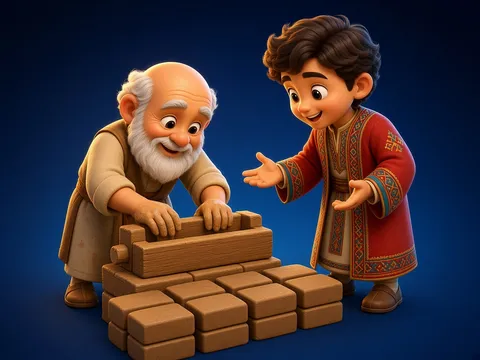
Nizami Ganjavi (about 1141–1209) was a great Azerbaijani poet who lived and wrote in Ganja. He wrote the “Khamsa” (Quintet), five long poems: “The Treasury of Mysteries”, “Khosrow and Shirin”, “Layla and Majnun”, “The Seven Beauties” and “The Book of Alexander”. The tale of the old brickmaker is one of the parables in “The Treasury of Mysteries”. An old man works hard in the heat making bricks. A young man passing by mocks him: why do such heavy work in old age when it earns so little? The old man answers that he earns his bread with his own hands so as not to depend on anyone or hold out his hand to beg; honest work is his dignity. With this tale Nizami praises respect for work and the honour of living by one’s own labour. The old man is wise, hard-working and noble; the young man at first does not see the value of work and is shown as arrogant. The original is in Persian, and there are Azerbaijani translations.
 What the book shows

In grade 5 literature lessons pupils learn that literature is the art of words and meet folk literature (legends, tales), poems, fables, short stories and classical poetry. Read the work in the textbook first, then answer the questions and write your own opinion.
Textbook link:
This is not the textbook’s text but a short description of the topic. Check the exact page in your own textbook.
 The lesson step by step
- 1
Warm-up5 min
An old man making bricks in the sun.
- 2
New topic10 min
Nizami and the Khamsa.
- 3
Practice10 min
Reading the tale.
- 4
Game10 min
The old man and the young man.
- 5
Wrap-up5 min
Discussing the value of work.
 Let’s understand
For the student Simple language
| Old man | Young man | |
|---|---|---|
| What does he do? | makes bricks | mocks |
| Character | wise, hard-working, noble | arrogant, impatient |
| His view | honest work is dignity | hard work is pointless |
 For the parent
How to help
- Talk with your child about a hard-working person in your family: what do they do, and why do we respect them?
 For the teacher
 Lesson goals
- Know the basics of Nizami Ganjavi’s life and work, retell the tale of the old brickmaker, compare the old man and the young man, and explain the idea (honest work and dignity).
How to teach it
- Expressive reading, text questions, character analysis, reading in parts, creative writing
 Differentiation
- Weaker pupils retell with a plan and key words; stronger pupils write their own text
 Questions for the class
- Why won’t the old man give up his hard work?
 How to check
The pupil gives key facts about Nizami, retells the tale, compares the characters and explains the idea.
 Scientific Scientific language
What is a parable?
A short tale with a lesson inside a long poem; Nizami explains his ideas through them.
Bricks
In the past bricks were shaped from clay in moulds and dried in the sun, which was very hard work.
Self-study
Step by step
- I gave the key facts about Nizami.
- I retold the tale.
- I compared the old man and the young man.
- I explained the idea.
Going deeper
 Scientific language: for older students, parents and teachers.
Nizami’s mausoleum stands in Ganja, and the literature museum in Baku and many streets and schools bear his name. 2021 was declared the Year of Nizami Ganjavi in Azerbaijan.
 Play and check
Whose is it: the old man’s or the young man’s?
 How to write it down
- Write a 4-point plan of the tale.
- Compare the old man and the young man in a table.
How the classwork looks in the notebook
Sample: the date and heading follow this country’s notebook rules.
 Watch out: common mistakes
 Where it helps in life
- Nature poetry
 At home
Core
- Retell the tale to your family and ask them what they think of the old man’s answer.
Extra ⭐
- Write a 6–8 sentence essay on the value of work.
How to do it
- Read the work aloud.
- Copy your favourite part and explain why you chose it.
Answers for parents
Check: the essay has a clear main idea, refers to Nizami’s tale and gives a real-life example.
Step-by-step homework solution — Show the solution (try it yourself first)
Think
- The old man earns little yet feels rich. Why? His greatest wealth is freedom and dignity: he owes no one and begs from no one. Nizami shows a person’s worth lies in honest work, not in how much they earn.
How the homework looks in the notebook
Sample: the date and heading follow this country’s notebook rules.

 About cookies