


Nature poetry


 About this lesson
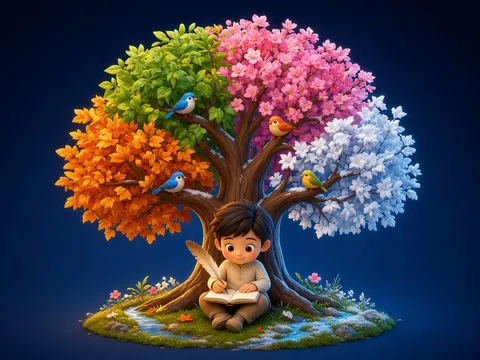
In a lyric poem the poet does not tell a story but expresses feelings and thoughts. In nature poetry these feelings come through scenes of nature: spring’s arrival can bring joy, falling autumn leaves sadness, winter’s silence calm. The “I” who expresses the feelings is the lyric hero. Poets bring nature to life with literary devices: an epithet is an artistic description (silvery snow, an emerald meadow); a simile compares one thing to another (snow is soft as cotton); personification gives living qualities to non-living things (the wind whistles, the river sings, the trees whisper). Azerbaijani poets such as Abdulla Shaig, Samad Vurgun, Mikayil Mushfig and others wrote many poems about nature and the seasons. When analysing a poem we ask: which season or scene is described? Which devices are used? What mood does it create?
 What the book shows

In grade 5 literature lessons pupils learn that literature is the art of words and meet folk literature (legends, tales), poems, fables, short stories and classical poetry. Read the work in the textbook first, then answer the questions and write your own opinion.
Textbook link:
This is not the textbook’s text but a short description of the topic. Check the exact page in your own textbook.
 The lesson step by step
- 1
Warm-up5 min
The four-season tree.
- 2
New topic10 min
Lyric poems and the lyric hero.
- 3
Practice10 min
Literary devices.
- 4
Game10 min
Finding a poem’s mood.
- 5
Wrap-up5 min
Writing our own poem.
 Let’s understand
For the student Simple language
| Device | What is it? | Example |
|---|---|---|
| epithet | an artistic description | gümüşü qar |
| simile | comparison with “like” | qar pambıq kimi |
| personification | the non-living as living | külək fit çalır |
 For the parent
How to help
- On a walk, describe nature with similes and personification together: “The clouds are like a flock of sheep”, “The trees dance with the wind”.
 For the teacher
 Lesson goals
- Know that in nature poetry the poet expresses feelings through scenes of nature, find epithets, similes and personification, decide a poem’s mood, and write a short poem or description of nature.
How to teach it
- Expressive reading, text questions, character analysis, reading in parts, creative writing
 Differentiation
- Weaker pupils retell with a plan and key words; stronger pupils write their own text
 Questions for the class
- How does a poet share feelings while describing nature?
 How to check
The pupil finds epithets, similes and personification in nature poems, explains the mood and writes a short description or poem.
 Scientific Scientific language
Season and mood
The same season can mean sadness to one poet and plenty to another.
Sounds
Poets imitate nature’s sounds with words: şırıltı (gurgle), xışıltı (rustle), vıyıltı (howl).
Self-study
Step by step
- I recognised a lyric poem.
- I found epithets, similes and personification.
- I named the mood.
- I wrote my own nature description.
Going deeper
 Scientific language: for older students, parents and teachers.
Some poems have become songs: composers have set nature poems to music, and they are sung as children’s songs.
 Play and check
Which device is it?
 How to write it down
- Describe your favourite season in 5–6 sentences with 2 epithets, 1 simile and 1 personification.
- Write its mood in one word.
How the classwork looks in the notebook
Sample: the date and heading follow this country’s notebook rules.
 Watch out: common mistakes
 Where it helps in life
- Grade 6: dastans and classical poetry
 At home
Core
- Learn a nature poem by heart and read it expressively.
Extra ⭐
- Write a 4-line poem about the view from your window.
How to do it
- Read the work aloud.
- Copy your favourite part and explain why you chose it.
Answers for parents
Example (a pupil’s own poem): the earth under a white quilt, the trees asleep, the wind bringing winter’s tale to the window. Devices: “white quilt” (an image for snow), “the trees sleep” and “the wind brings a tale” (personification).
Step-by-step homework solution — Show the solution (try it yourself first)
Think
- Two poets describe autumn: one says “the leaves fall weeping”, the other “the orchards are wrapped in gold”. The first is sad, the second joyful. So nature poetry shows the poet’s heart as well as nature.
How the homework looks in the notebook
Sample: the date and heading follow this country’s notebook rules.

 About cookies