


Probability

 About this lesson
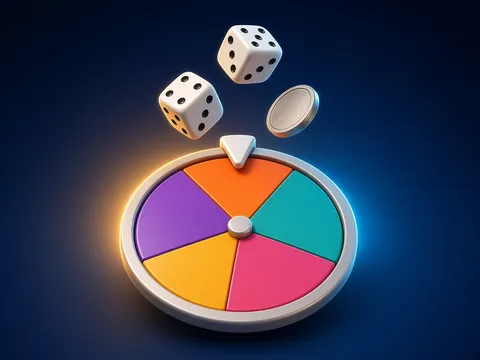
Some events are certain: a die will land on less than 7. Some are impossible: an ordinary die will not show 8. Many are possible — they may happen or may not: rolling a 6. Probability tells the chance of an event. It is a number from 0 to 1: an impossible event has probability 0 and a certain one 1. When all outcomes are equally likely, probability = number of favourable outcomes ÷ number of all outcomes. A coin has 2 outcomes (heads or tails), so the chance of heads is 1/2. A die has 6 faces: the chance of a 6 is 1/6, and of an even number (2, 4, 6) is 3/6 = 1/2. If a bag holds 3 red balls and 1 blue ball, the chance of drawing blue is 1/4 and red 3/4. Probability does not predict the result: in 6 rolls you might not get a 6 at all. But the more times you repeat an experiment, the closer the results get to the probability.
 What the book shows

In the grade 5 maths textbook a topic usually comes with a real-life example, a rule, a worked example and tasks of different difficulty. Read the example carefully, say the rule in your own words, then solve the tasks in your notebook and check the answer.
Textbook link:
This is not the textbook’s text but a short description of the topic. Check the exact page in your own textbook.
 The lesson step by step
- 1
Warm-up5 min
A die and a coin in the air.
- 2
New topic10 min
Certain, impossible, possible.
- 3
Practice10 min
The probability scale.
- 4
Game10 min
Probability as a fraction.
- 5
Wrap-up5 min
The spinner problem.
 Let’s understand
For the student Simple language
| Event | Type | Probability |
|---|---|---|
| rolling an 8 | impossible | 0 |
| rolling a 6 | possible | 1/6 |
| coin shows heads | possible | 1/2 |
| die shows less than 7 | certain | 1 |
 For the parent
How to help
- Toss a coin 20 times together, record the results in a table, and compare the number of heads with the probability of 1/2.
 For the teacher
 Lesson goals
- Tell certain, impossible and possible events apart, place events on a probability scale, and write probability as a fraction in simple experiments.
How to teach it
- Modelling, worked examples, pair problem-solving, estimating and checking, independent work
 Differentiation
- Weaker pupils work step by step from a model; stronger pupils solve multi-step problems and write their own
 Questions for the class
- How can we measure the chance of an event?
 How to check
The pupil tells event types apart, places them on a probability scale and works out simple probabilities as fractions.
 Scientific Scientific language
The probability scale
0 is impossible, 1/2 is an even chance and 1 is certain.
An experiment
Toss a coin 20 times; you usually get about 10 heads, but not always exactly 10.
Self-study
Step by step
- I told event types apart.
- I placed events on a scale.
- I wrote probability as a fraction.
- I did an experiment.
Going deeper
 Scientific language: for older students, parents and teachers.
The foundations of probability theory were laid in the 17th century in letters between the French scholars Pascal and Fermat.
 Play and check
What type of event is it?
 How to write it down
- For a die, find the probability of a 3, of more than 5 and of an odd number.
- A bag holds 2 red, 3 green and 5 yellow balls. Write the probability of each colour.
- Draw a probability scale and place 4 events on it.
How the classwork looks in the notebook
Sample: the date and heading follow this country’s notebook rules.
 Watch out: common mistakes
 Where it helps in life
- Grade 6 mathematics
 At home
Core
- Roll a die 30 times and record how often each number comes up. Compare with the probability of 1/6.
Extra ⭐
- Think of an event with probability 0, one with 1/2 and one with 1.
How to do it
- Solve the tasks in your notebook.
- Check each answer by estimating or with the inverse operation.
Answers for parents
Die: a 3 — 1/6; more than 5 (only 6) — 1/6; odd (1, 3, 5) — 3/6 = 1/2. Bag (10 balls): red 2/10 = 1/5, green 3/10, yellow 5/10 = 1/2. Homework: in 30 rolls each number may come up about 5 times, but not necessarily exactly 5.
Step-by-step homework solution — Show the solution (try it yourself first)
Let’s solve
- A spinner has 8 equal sections: 4 red, 3 blue and 1 yellow. Which colour is most likely? Red 4/8 = 1/2, blue 3/8, yellow 1/8. Red is most likely and yellow least. The probabilities add up to 4/8 + 3/8 + 1/8 = 1.
How the homework looks in the notebook
Sample: the date and heading follow this country’s notebook rules.

 About cookies