


Volume of a cuboid


 About this lesson
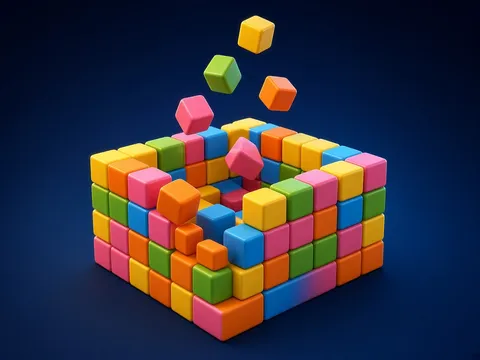
A matchbox, a brick and a book are shaped like cuboids. A cuboid has 6 faces (all rectangles), 12 edges and 8 vertices. It has three dimensions: length (a), width (b) and height (c). A cuboid whose edges are all equal is a cube. Volume tells how much space a solid takes up. We measure it with unit cubes: a cube with 1 cm edges has a volume of 1 cubic centimetre (1 cm³). The volume of a cuboid is how many unit cubes fit inside: V = a · b · c. A 4 cm by 3 cm by 2 cm box holds 4 · 3 = 12 cubes in one layer and 24 cubes in two layers, so V = 24 cm³. The volume of a cube is V = a · a · a = a³; a cube with 3 cm edges has 27 cm³. Units: 1 dm³ = 1000 cm³ and 1 m³ = 1000 dm³. Liquids are measured in litres: 1 l = 1 dm³, so a cube-shaped container with 10 cm edges holds 1 litre. When working out volume, all the measurements must be in the same unit.
 What the book shows

In the grade 5 maths textbook a topic usually comes with a real-life example, a rule, a worked example and tasks of different difficulty. Read the example carefully, say the rule in your own words, then solve the tasks in your notebook and check the answer.
Textbook link:
This is not the textbook’s text but a short description of the topic. Check the exact page in your own textbook.
 The lesson step by step
- 1
Warm-up5 min
A box built from cubes.
- 2
New topic10 min
Cuboids and cubes.
- 3
Practice10 min
Unit cubes and volume.
- 4
Game10 min
V = a · b · c.
- 5
Wrap-up5 min
Litres and a pool.
 Let’s understand
For the student Simple language
| Dimensions | Working | Volume |
|---|---|---|
| 4 cm, 3 cm, 2 cm | 4 · 3 · 2 | 24 cm³ |
| 5 cm, 2 cm, 3 cm | 5 · 2 · 3 | 30 cm³ |
| cube, a = 3 cm | 3 · 3 · 3 | 27 cm³ |
| cube, a = 10 cm | 10 · 10 · 10 | 1000 cm³ = 1 l |
 For the parent
How to help
- Measure a box at home with a ruler and work out its volume together; compare it with the litres printed on a milk carton.
 For the teacher
 Lesson goals
- Know the parts of a cuboid and a cube, understand volume, use V = a · b · c, and link the units of volume (cm³, dm³, m³, litre).
How to teach it
- Modelling, worked examples, pair problem-solving, estimating and checking, independent work
 Differentiation
- Weaker pupils work step by step from a model; stronger pupils solve multi-step problems and write their own
 Questions for the class
- How many unit cubes fit in the box?
 How to check
The pupil counts a cuboid’s parts, works out volume with V = a · b · c and converts units of volume.
 Scientific Scientific language
The layer model
Count the cubes in one layer (a · b), then multiply by the number of layers (c).
The water test
1 litre of water exactly fills a cube-shaped container with 10 cm edges.
Self-study
Step by step
- I counted faces, edges and vertices.
- I found volume with unit cubes.
- I used V = a · b · c.
- I converted units.
 Terms in this lesson
Tap an underlined word — its meaning opens in the glossary.
- Volume
- The space a solid fills; in cubic units: cm³.
Going deeper
 Scientific language: for older students, parents and teachers.
According to legend, the ancient Greek scholar Archimedes came up with finding an object’s volume from how much water it pushes up.
 Play and check
What is the volume?
 How to write it down
- Work out the volume for 6 cm, 5 cm, 4 cm and for a cube with a = 5 cm.
- Convert: 3 dm³ = ? cm³; 2 l = ? dm³; 5000 cm³ = ? l.
- An aquarium measures 50 cm, 30 cm and 40 cm. How many litres does it hold?
How the classwork looks in the notebook
Sample: the date and heading follow this country’s notebook rules.
 Watch out: common mistakes
 Where it helps in life
- Probability
 At home
Core
- Measure 2 boxes at home, work out their volumes and compare them.
Extra ⭐
- How many 1 cm cubes make up a cube with 1 dm edges?
How to do it
- Solve the tasks in your notebook.
- Check each answer by estimating or with the inverse operation.
Answers for parents
6 · 5 · 4 = 120 cm³; 5 · 5 · 5 = 125 cm³. 3 dm³ = 3000 cm³; 2 l = 2 dm³; 5000 cm³ = 5 l. Aquarium: 50 · 30 · 40 = 60 000 cm³ = 60 l. Homework: 10 · 10 · 10 = 1000 cubes.
Step-by-step homework solution — Show the solution (try it yourself first)
Let’s solve
- A pool is 10 m long, 5 m wide and 2 m deep. How many m³ of water does it hold? V = 10 · 5 · 2 = 100 m³. Since 1 m³ = 1000 l, that is 100 000 litres.
How the homework looks in the notebook
Sample: the date and heading follow this country’s notebook rules.

 About cookies