


Digestion, breathing and circulation


 About this lesson
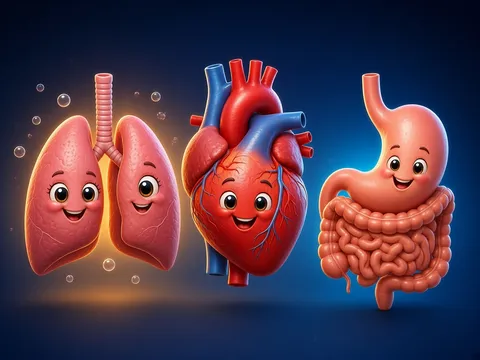
The digestive system breaks food into tiny particles the body can use. Food’s path is: mouth (teeth chew, saliva moistens) → oesophagus → stomach (food mixes with gastric juice) → small intestine (useful substances pass into the blood) → large intestine (water is absorbed and waste leaves the body). The liver helps digestion too. The respiratory system supplies the body with oxygen. Air’s path is: nose (air is warmed and cleaned) → larynx → windpipe (trachea) → bronchi → lungs. In tiny air sacs in the lungs oxygen passes into the blood, and carbon dioxide passes from the blood into the lungs and is breathed out. The circulatory system is the heart and blood vessels. The heart is a four-chambered muscular pump. Arteries carry blood from the heart to the organs, veins carry it back to the heart, and the finest vessels, capillaries, reach every cell. Blood brings cells oxygen and nutrients and carries away waste. The three systems work together: digestion supplies nutrients, breathing supplies oxygen, and the blood delivers them all over the body.
 What the book shows

In grade 5 Natural Science covers the human body and health, the diversity of living things, substances and their properties, energy, force and motion, and the environment. Read the topic in the textbook, do simple experiments with an adult watching, and record what you observe in your notebook.
Textbook link:
This is not the textbook’s text but a short description of the topic. Check the exact page in your own textbook.
 The lesson step by step
- 1
Warm-up5 min
Counting our pulse.
- 2
New topic10 min
Food’s journey.
- 3
Practice10 min
Air’s path.
- 4
Game10 min
The heart and vessels.
- 5
Wrap-up5 min
Three systems, one team.
 Let’s understand
For the student Simple language
| System | Organs | Job |
|---|---|---|
| digestive | mouth, stomach, intestines | breaks food down |
| respiratory | nose, windpipe, lungs | takes in oxygen |
| circulatory | heart, blood vessels | carries everything |
 For the parent
How to help
- Count your child’s pulse at rest and after a minute of jumping, and talk about the difference.
 For the teacher
 Lesson goals
- Know the organs and work of the digestive, respiratory and circulatory systems, explain the path of food and air in the body, and show how the systems are linked.
How to teach it
- Observation, simple experiments, building models, tables and diagrams, mini-research
 Differentiation
- Weaker pupils work from pictures and diagrams; stronger pupils plan their own experiment and draw conclusions
 Questions for the class
- How do food and air reach every cell of the body?
 How to check
The pupil traces the paths of food and air, explains the heart and vessels, and shows how the three systems work together.
 Scientific Scientific language
The pulse
Touch your wrist and you feel the artery beat — the pulse shows the heartbeat.
Breathe through your nose
Hairs and mucus in the nose trap dust, so nose-breathing is good for you.
Self-study
Step by step
- I traced the path of food.
- I traced the path of air.
- I explained the heart and vessels.
- I showed how the systems link.
Going deeper
 Scientific language: for older students, parents and teachers.
At rest an adult heart beats about 60–100 times a minute; children’s pulses are usually a little faster.
 Play and check
Which system does it belong to?
 How to write it down
- Draw food’s path as an arrow diagram.
- Record your pulse experiment in a table.
How the classwork looks in the notebook
Sample: the date and heading follow this country’s notebook rules.
 Watch out: common mistakes
 Where it helps in life
- Vertebrates and invertebrates
 At home
Core
- Count your pulse in the morning, after school and after exercise, and compare.
Extra ⭐
- Write 5 tips for a healthy heart.
How to do it
- Read the topic in the textbook.
- Copy the key words and diagram into your notebook, then make one simple observation and record it.
Answers for parents
Expected result: the pulse is faster after exercise because the muscles need more oxygen, and it slows again after rest.
Step-by-step homework solution — Show the solution (try it yourself first)
Think
- How do breakfast and fresh air help you concentrate? The brain is made of cells that need nutrients and oxygen. Digestion and breathing supply them and the blood delivers them to the brain. Hungry, in a stuffy room, concentration soon drops.
How the homework looks in the notebook
Sample: the date and heading follow this country’s notebook rules.

 About cookies