


Mixtures and separating them


 About this lesson
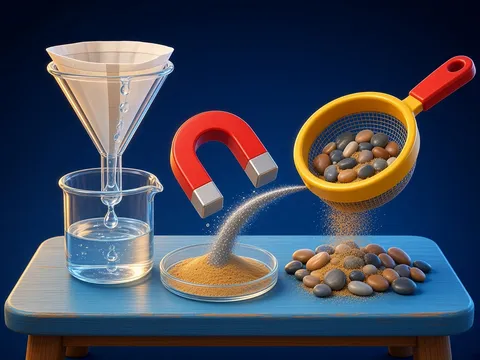
A pure substance is made of only one substance (distilled water, sugar, iron). A mixture is two or more substances mixed together (soil, sea water, air, a salad). Each substance in a mixture keeps its own properties, so they can be separated. In some mixtures you can see the parts (sand and stones); in others you cannot — for example, salt dissolving in water makes a solution. Each separation method uses a difference in properties. Sieving separates particles of different sizes (flour and bran, sand and gravel). A magnet attracts iron (iron filings and sand). Settling lets heavy insoluble particles sink to the bottom so the water on top can be poured off carefully. Filtering passes the mixture through filter paper or cloth: water goes through, insoluble solids such as sand or clay stay behind. Evaporating heats a solution so the water evaporates and the dissolved solid (salt) is left in the dish. Sometimes methods are used in turn: add water to a sand-and-salt mixture, filter it (sand is left), then evaporate the liquid (salt is left). These methods are used in kitchens, building work and water-treatment plants.
 What the book shows

In grade 5 Natural Science covers the human body and health, the diversity of living things, substances and their properties, energy, force and motion, and the environment. Read the topic in the textbook, do simple experiments with an adult watching, and record what you observe in your notebook.
Textbook link:
This is not the textbook’s text but a short description of the topic. Check the exact page in your own textbook.
 The lesson step by step
- 1
Warm-up5 min
Sand, salt and iron: how do we separate them?
- 2
New topic10 min
Pure substances and mixtures.
- 3
Practice10 min
Separation methods.
- 4
Game10 min
Choosing a method.
- 5
Wrap-up5 min
A mini lab.
 Let’s understand
For the student Simple language
| Method | Which difference it uses | Example |
|---|---|---|
| sieving | size | sand + gravel |
| magnet | attraction to a magnet | iron + sand |
| filtering | dissolving or not | sand + water |
| evaporating | evaporation | salty water |
 For the parent
How to help
- Try a safe kitchen experiment: mix sand and salt, add water, filter through a paper towel and leave the liquid on a windowsill for a few days — salt crystals will remain.
 For the teacher
 Lesson goals
- Tell a pure substance from a mixture, know the ways of separating mixtures (sieving, using a magnet, settling, filtering, evaporating), and choose the right one for a given mixture.
How to teach it
- Observation, simple experiments, building models, tables and diagrams, mini-research
 Differentiation
- Weaker pupils work from pictures and diagrams; stronger pupils plan their own experiment and draw conclusions
 Questions for the class
- How do we choose a way to separate a mixture?
 How to check
The pupil tells pure substances from mixtures, names the methods and chooses the right ones, in order, for a given mixture.
 Scientific Scientific language
Sea salt
Salt is obtained by evaporating water from salt lakes and sea water, with the sun doing the work.
Water treatment
Town water is first left to settle, then passed through sand and other filters.
Self-study
Step by step
- I told pure substances from mixtures.
- I named 5 separation methods.
- I chose a method for a mixture.
- I planned how to separate sand and salt.
Going deeper
 Scientific language: for older students, parents and teachers.
Crude oil is a mixture too: refineries heat it and separate it into parts such as petrol, kerosene and fuel oil.
 Play and check
Which method would separate it?
 How to write it down
- Draw a filtering set-up and label its parts.
- Write a 4-step plan to separate a mixture of sand, salt and iron filings.
How the classwork looks in the notebook
Sample: the date and heading follow this country’s notebook rules.
 Watch out: common mistakes
 Where it helps in life
- Kinds of energy and how it changes
 At home
Core
- Find 5 mixtures at home and write how each could be separated.
Extra ⭐
- Do the sand-and-salt experiment and show the result with drawings.
How to do it
- Read the topic in the textbook.
- Copy the key words and diagram into your notebook, then make one simple observation and record it.
Answers for parents
Plan: 1) remove the iron filings with a magnet; 2) add water and stir so the salt dissolves; 3) filter: sand stays in the filter; 4) evaporate the liquid: salt is left.
Step-by-step homework solution — Show the solution (try it yourself first)
Think
- When we make tea we use a strainer. Which method is that, and what does it rely on? It is filtering: the dissolved substances pass through with the water while the undissolved tea leaves stay in the strainer. We use science every day without noticing.
How the homework looks in the notebook
Sample: the date and heading follow this country’s notebook rules.

 About cookies